
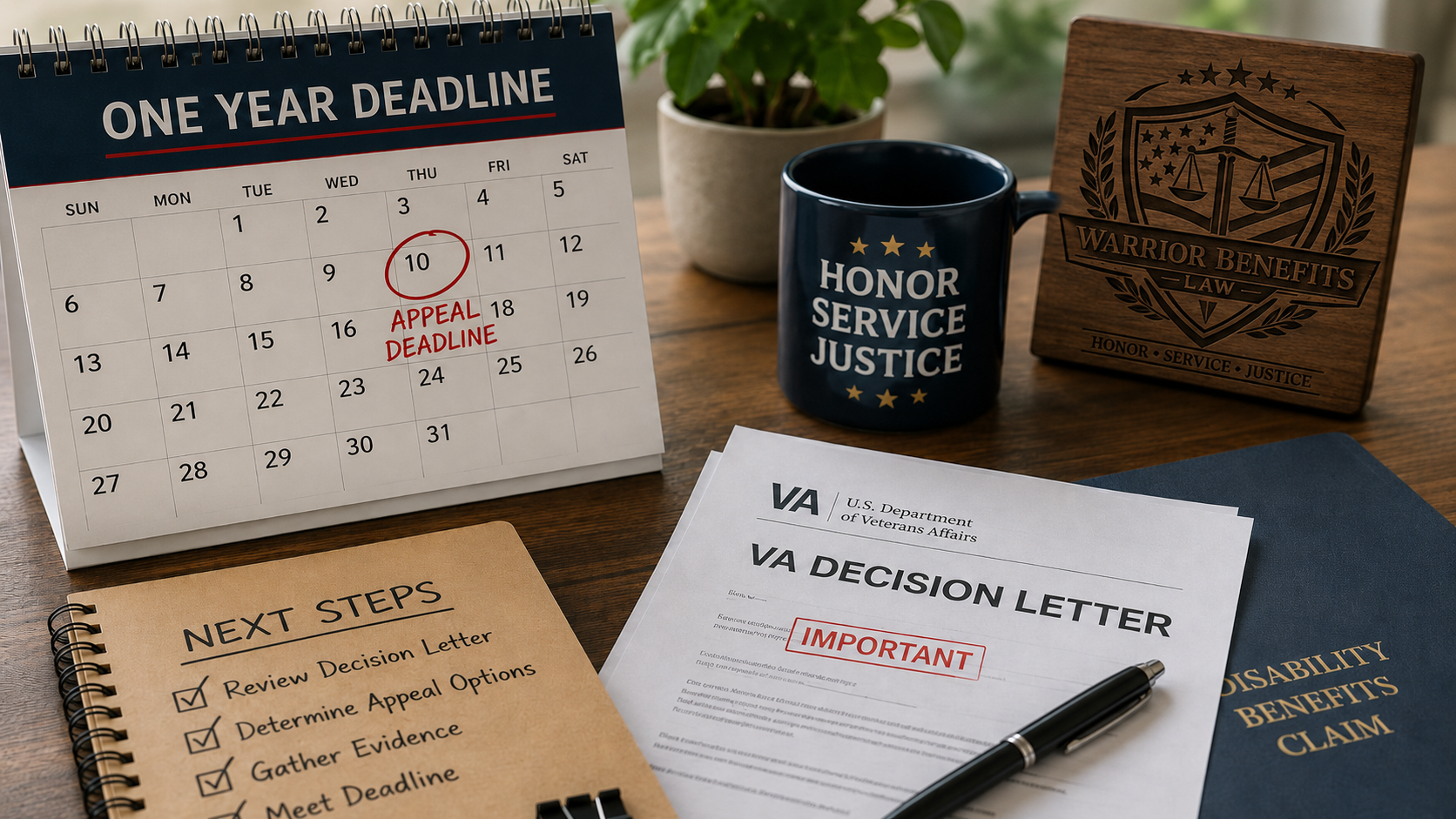
When VA denies a disability claim, assigns a lower rating than expected, or gives the wrong effective date, the first question is usually:
What do I do next?
The second question should be:
How much time do I have?
Deadlines matter in VA disability claims. A Veteran may have strong evidence, a real service-connected disability, and a good appeal issue, but waiting too long can make the case harder and may affect potential back pay.
For many VA disability decisions, the key deadline is one year from the date on the VA decision letter.
That does not mean every situation is simple. Different review options have different rules. Some options allow new evidence. Some do not. Some options may protect an effective date if used correctly and on time. Others may be available later but may not preserve the same potential back pay.
This article explains the one-year rule in plain English and why Veterans should review a VA decision letter before filing the next form.
Start with the date on the VA decision letter
The first step is to look at the date on the VA decision letter.
Do not rely only on the date you opened the letter, the date you saw it in VA.gov, or the date you talked to someone about the decision.
Start with the date on the decision letter.
That date matters because many review deadlines are calculated from the decision letter date.
After you find the date, count forward one year. That is the window Veterans should treat seriously when deciding whether to request review.
What are the main review options after a VA decision?
If a Veteran disagrees with a VA benefits decision, the main review options are usually:
- Supplemental Claim
- Higher-Level Review
- Board Appeal
Each option has a different purpose.
The mistake many Veterans make is thinking all appeal options are basically the same. They are not.
The right option depends on what went wrong in the VA decision.
Supplemental Claim
A Supplemental Claim is generally used when the Veteran has new and relevant evidence.
This may include:
- New medical records
- A nexus opinion
- A Disability Benefits Questionnaire
- Lay statements
- Buddy statements
- Updated treatment records
- Private treatment records
- Employment records
- Evidence showing worsening symptoms
- Evidence connecting a secondary condition
A Supplemental Claim can be useful when VA denied the claim because the record was missing something important.
For example, if VA denied a knee condition because there was no medical nexus, the Veteran may need new and relevant evidence explaining the connection between the current condition and service.
Higher-Level Review
Higher-Level Review is generally used when VA made a mistake based on the evidence already in the file.
No new evidence is allowed in a Higher-Level Review.
This lane may fit when VA:
- Ignored favorable evidence
- Misread a medical record
- Overlooked lay evidence already in the file
- Applied the wrong rule
- Relied on an inadequate exam
- Assigned the wrong effective date based on the existing record
- Underrated symptoms already documented in the claim file
Higher-Level Review may be a good option when the file already contains what VA needed to make the right decision.
But if the case needs more evidence, Higher-Level Review may not fix the problem.
Board Appeal
A Board Appeal sends the case to the Board of Veterans’ Appeals for review by a Veterans Law Judge.
This may be appropriate when the case needs judge-level review, when the issue involves legal error, when VA repeatedly misses the point, or when the Veteran wants one of the Board review options.
Board Appeals can be powerful, but they can also take longer.
A Veteran should think carefully before choosing the Board route, especially if a missing medical opinion or lay statement could be developed faster through a Supplemental Claim.
Why the one-year deadline matters
The one-year deadline matters because waiting too long can reduce options.
For Higher-Level Review, VA says the request must generally be made within one year of the decision on the initial claim or Supplemental Claim, and the one-year period starts from the date on the decision letter.
For Board Appeals, VA says the request generally must be submitted within one year of the decision on the initial claim, Supplemental Claim, or Higher-Level Review.
Supplemental Claims may sometimes be filed later, but timing still matters. VA explains that switching to a Supplemental Claim within one year may help keep the effective date.
That effective-date issue can be very important.
What is an effective date?
The effective date is the date VA uses to decide when benefits should begin.
If VA later grants the claim, the effective date can affect how much past-due compensation the Veteran receives.
This is why timing matters.
A Veteran who files the right review option within the correct deadline may be in a better position to preserve the earliest possible date. A Veteran who waits too long may still have options, but the past-due benefit picture can become more complicated.
Do not assume that a later filing will protect the same back pay.
Do not wait until the last week
Even if the deadline is one year, Veterans should not wait until the last week to act.
That leaves little time to:
- Review the VA decision letter
- Identify the reason for denial
- Request the C&P exam report
- Gather missing medical records
- Ask for lay statements
- Obtain a medical opinion
- Compare appeal options
- Prepare the correct form
- Submit the request safely
- Confirm VA received it
Waiting until the deadline is close can force a rushed decision.
Rushed decisions often lead to the wrong appeal lane.
The deadline does not tell you which lane to choose
Knowing the deadline is only part of the answer.
The more important question is:
What kind of problem are we fixing?
If VA denied the claim because the file was missing medical nexus evidence, a Supplemental Claim may make more sense.
If VA already had the evidence and ignored it, Higher-Level Review may make more sense.
If the issue needs judge-level review or involves a significant legal dispute, a Board Appeal may make more sense.
A Veteran should not choose an appeal lane just because it sounds faster or simpler.
The lane should match the problem.
Common deadline mistakes
Veterans often make avoidable mistakes after a VA decision.
Mistake 1: Assuming the decision is final
A VA denial is not always the end. Veterans usually have review options after a decision.
Mistake 2: Waiting because the decision feels overwhelming
A denial can be frustrating, but waiting without a plan can create deadline problems.
Mistake 3: Filing the same information again
If VA denied the claim because evidence was missing, resubmitting the same evidence may not fix the issue.
Mistake 4: Choosing Higher-Level Review when new evidence is needed
Higher-Level Review does not allow new evidence. If the record is incomplete, this may be the wrong lane.
Mistake 5: Missing the effective-date issue
The rating percentage matters, but the effective date can also affect past-due benefits.
Mistake 6: Assuming a Supplemental Claim later will preserve everything
A Supplemental Claim may still be available later in some cases, but Veterans should not assume a later filing preserves the same effective date.
What Veterans should do after receiving a VA decision
After receiving a VA decision, Veterans should take these steps:
- Save the decision letter.
- Identify the date on the letter.
- Calendar the one-year deadline.
- Read the “Reasons for Decision” section.
- List each issue VA granted, denied, or underrated.
- Identify any favorable findings.
- Review the evidence VA considered.
- Look for missing medical records or lay evidence.
- Decide whether the case needs new evidence.
- Choose the appeal lane based on the actual problem.
The decision letter is the roadmap.
Do not just look at the final percentage.
What evidence should Veterans gather before the deadline?
The evidence depends on the issue, but Veterans should consider gathering:
- VA decision letter
- Rating decision
- Code sheet, if available
- C&P exam reports
- VA medical records
- Private medical records
- Service treatment records
- DD214
- Lay statements
- Buddy statements
- Nexus opinions
- DBQs
- Employment records
- Records showing missed work
- Records showing daily functional limits
VA says disability claim evidence may include separation documents, service treatment records, medical evidence, and lay evidence from the Veteran or someone who knows about the condition or related events.
Lay evidence can be very important because not every symptom appears neatly in a medical record.
What if the one-year deadline already passed?
If the one-year deadline has already passed, do not assume there is nothing left to do.
A Supplemental Claim may still be possible if there is new and relevant evidence. But the effective-date issue may become more complicated.
A Veteran may also need to consider whether there are other legal issues, such as a pending claim, a missed VA duty, or another basis to challenge the decision. These situations are fact-specific.
The key point is this: if the deadline already passed, get organized quickly and review the decision carefully.
Why an attorney or accredited representative may help
VA-accredited attorneys, claims agents, and Veterans Service Organization representatives can help Veterans request decision reviews.
That help can matter when the Veteran is trying to decide:
- Whether new evidence is needed
- Whether Higher-Level Review is appropriate
- Whether a Board Appeal is worth the wait
- Whether the effective date is wrong
- Whether VA ignored favorable evidence
- Whether the C&P exam was inadequate
- Whether secondary conditions were missed
- Whether TDIU should be considered
The right help should start with the decision letter and the reason VA gave.
Generic advice is not enough.
Example: missing nexus evidence
A Veteran files for a back condition.
VA denies the claim because there is no medical link between the current diagnosis and service.
The Veteran has a diagnosis. The Veteran also had back problems in service. But the file does not contain a medical opinion connecting the two.
In that situation, a Supplemental Claim with a new medical opinion may be stronger than a Higher-Level Review.
The issue is not just disagreement. The issue is missing evidence.
Example: VA ignored favorable evidence
A Veteran files for an increased PTSD rating.
The file already contains treatment records, lay statements, and a C&P exam showing symptoms that support a higher rating.
VA assigns a lower rating anyway and fails to discuss important evidence.
In that situation, Higher-Level Review may be worth considering because the evidence was already in the file.
The issue is not missing evidence. The issue may be VA error.
Example: Board review may be appropriate
A Veteran has already been through a Supplemental Claim or Higher-Level Review, but VA continues to deny the issue despite strong evidence.
Or the case involves a legal question, repeated factual mistakes, or a dispute that needs judge-level review.
A Board Appeal may be appropriate.
But the Veteran should understand the Board options, evidence rules, and expected timelines before filing.
Veterans in Virginia and Hampton Roads should act early
Veterans in Yorktown, Newport News, Hampton, Norfolk, Chesapeake, Virginia Beach, Williamsburg, Richmond, and across Virginia should treat the one-year deadline as a planning deadline, not a last-minute filing deadline.
The earlier the decision is reviewed, the more time there is to build the right strategy.
That can make the difference between filing a rushed form and filing a focused appeal.
Bottom line
If VA denied your disability claim, underrated your condition, or assigned the wrong effective date, do not wait until the deadline is close.
Start with the date on the VA decision letter. Calendar the one-year deadline. Then review why VA made the decision.
The right appeal lane depends on the reason for the denial.
A Supplemental Claim may fit when new and relevant evidence is needed. Higher-Level Review may fit when VA made an error based on the existing record. A Board Appeal may fit when judge-level review is needed.
The one-year rule matters because it can affect your options and may affect your effective date.
Do not just appeal. Appeal correctly.
This article is for general information only and is not legal advice. Reading this article or contacting Warrior Benefits Law does not create an attorney-client relationship unless we agree to representation in writing.
Sources
- VA: Decision reviews and appeals
- VA: Supplemental Claims
- VA: Higher-Level Reviews
- VA: Board Appeals
- VA: After you request a decision review
- VA: Evidence needed for your disability claim
- VA: Get help from a VA-accredited representative or VSO
More articles you may find useful
These suggestions are selected from published Warrior Benefits Law articles and may rotate as new posts are added.

Yorktown and Hampton Roads Veterans: What to Do After a VA Disability Denial
If VA denied your disability claim or assigned a lower rating than expected, the next step matters. Here is what Veterans in Yorktown, Newport News, Hampton Roads, and across Virginia should know before choosing an appeal lane.
Read article
VA-Accredited Attorney Near Me? What Virginia Veterans Should Know Before Choosing Help
If your VA disability claim was denied or underrated, choosing the right help matters. Here is what Virginia Veterans should know about VA-accredited attorneys, VSOs, claims agents, and red flags to avoid.
Read article
Top Mistakes Veterans Make After a VA Denial
After a VA denial, the next move matters. The most common mistakes involve missing deadlines, choosing the wrong review lane, sending unfocused evidence, and ignoring weak exams.
Read article
Why Do Many Veterans Miss Out on VA Benefits?
Many veterans miss out on VA benefits because they wait too long, file without the right evidence, overlook secondary conditions, or choose the wrong appeal lane after a denial.
Read article
How to Win a VA Appeal by Choosing the Right Strategy
Winning a VA appeal usually starts with understanding the denial, choosing the right review lane, and building focused evidence that answers the reason VA denied the claim.
Read article
Why Warrior Benefits Law Takes a Different Approach to VA Disability Appeals
Veterans have many choices after a VA denial. Warrior Benefits Law combines firsthand military and VA claims experience with VA-accredited, attorney-led strategy, focused evidence development, and honest guidance.
Read article