
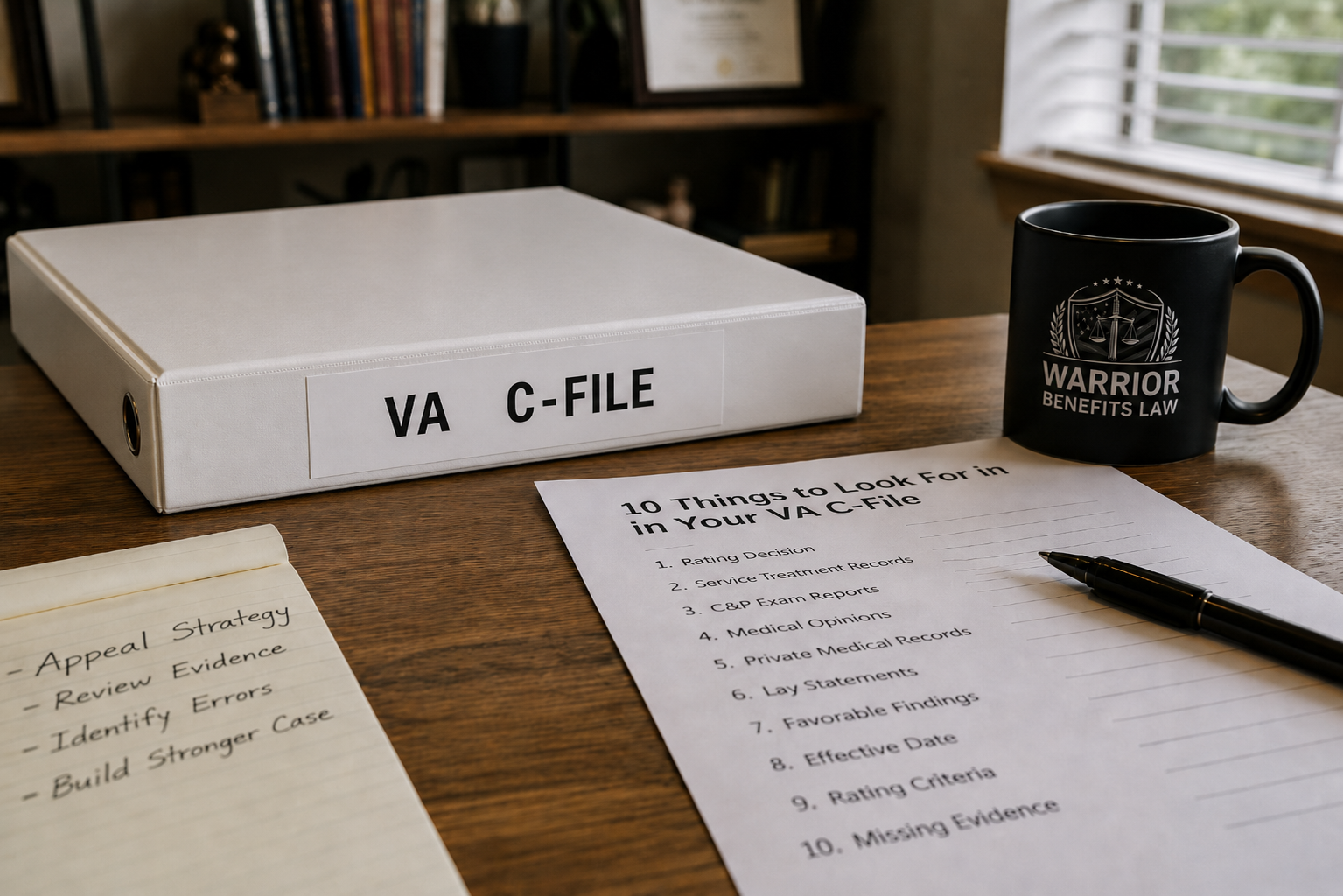
How to Read Your VA C-File Before Appealing
A VA C-file can feel overwhelming.
Depending on the Veteran’s claim history, it may contain hundreds or thousands of pages. It may include rating decisions, service treatment records, military personnel records, VA medical records, private medical records, C&P exams, medical opinions, lay statements, appeal forms, correspondence, and prior VA decisions.
For many Veterans, the problem is not that the file is empty.
The problem is knowing what to look for.
A C-file is not just a pile of records. It is the story VA used to decide the claim. If VA denied the claim, assigned a low rating, or chose the wrong effective date, the C-file may show why.
Before filing a Supplemental Claim, Higher-Level Review, or Board Appeal, Veterans should slow down and review the record carefully.
Here are 10 things to look for.
1. The Decision Letter and Rating Decision
Start with the decision letter.
A Veteran should identify exactly what VA decided. Did VA deny service connection? Grant service connection but assign a low rating? Deny an increased rating? Deny TDIU? Assign the wrong effective date?
The rating decision is the roadmap.
Look for:
- the issues decided,
- the outcome for each issue,
- the rating percentage assigned,
- the effective date,
- the evidence VA listed,
- the favorable findings,
- and the reasons VA gave for the decision.
Do not skip the “reasons for decision” section.
That section often reveals the missing piece. VA may say there was no current diagnosis, no in-service event, no medical nexus, no evidence of worsening, or no evidence supporting a higher rating.
The appeal strategy should respond to the actual reason VA gave.
2. Favorable Findings
Favorable findings are important.
In many modern VA decisions, VA may concede certain facts even when denying the claim. For example, VA may concede:
- a current diagnosis,
- an in-service event,
- toxic exposure,
- service in a qualifying location,
- a service-connected primary disability,
- or participation in certain military duties.
A favorable finding can narrow the fight.
If VA already conceded the diagnosis and the in-service event, the appeal may need to focus on nexus. If VA conceded service connection but assigned a low rating, the appeal may need to focus on severity. If VA conceded a primary service-connected condition, the appeal may need to focus on secondary service connection.
Do not waste the appeal re-proving what VA already accepted.
Focus on what VA still disputed.
3. The Evidence VA Listed
Every rating decision should identify the evidence VA considered.
Compare that evidence list to what you actually submitted.
Ask:
- Did VA list the private medical records?
- Did VA list the lay statement?
- Did VA list the buddy statement?
- Did VA list the correct C&P exam?
- Did VA list the service treatment records?
- Did VA list the personnel records?
- Did VA list the nexus opinion?
- Did VA list records from the right time period?
If something important is missing from the evidence list, that may be significant.
Sometimes evidence was never uploaded. Sometimes it was uploaded but overlooked. Sometimes the record was present, but VA did not discuss it meaningfully.
This is one of the most important reasons to review the C-file before appealing.
4. Service Treatment Records
Service treatment records may show injuries, complaints, diagnoses, profiles, medications, referrals, physical therapy, mental health treatment, or other in-service events.
But many Veterans have incomplete service treatment records.
Some conditions were never documented. Some Veterans avoided medical care because of military culture, mission demands, leadership pressure, fear of career consequences, or simply because they pushed through pain.
When reviewing service treatment records, look for:
- complaints related to the claimed condition,
- relevant injuries,
- sick-call visits,
- profiles or duty limitations,
- medication history,
- imaging or lab results,
- mental health notes,
- deployment-related symptoms,
- separation exam findings,
- and repeated complaints that show a pattern.
Also look for what is missing.
If the service treatment records are silent, the appeal may need strong lay evidence, buddy statements, personnel records, deployment history, or medical opinion evidence explaining why the current disability is still related to service.
5. Military Personnel Records
Personnel records can be just as important as medical records.
They may show where the Veteran served, what duties the Veteran performed, deployments, occupational specialty, performance reports, disciplinary issues, training, awards, exposure history, or changes in performance over time.
Personnel records may help support claims involving:
- PTSD,
- military sexual trauma,
- toxic exposure,
- airborne hazards,
- noise exposure,
- joint injuries from military duties,
- traumatic brain injury,
- combat events,
- security or law-enforcement duties,
- aircraft or vehicle maintenance,
- intelligence or operations work,
- and other service-related events.
A Veteran’s MOS, AFSC, Rating, or SFSC may help explain what the Veteran actually did in service.
Sometimes the personnel records tell the story that the medical records do not.
6. C&P Exams and Medical Opinions
C&P exams are often the turning point in a VA disability claim.
VA explains that a claim exam can help determine whether a Veteran has a service-connected disability and how severe the disability is. VA also states that the examiner may ask questions based on the medical records in the claim file and may use Disability Benefits Questionnaires, commonly called DBQs.
When reviewing a C&P exam, ask:
- Did the examiner review the correct records?
- Did the examiner accurately describe the Veteran’s history?
- Did the examiner discuss the Veteran’s lay statements?
- Did the examiner address service treatment records?
- Did the examiner address private medical records?
- Did the examiner explain the medical opinion?
- Did the examiner rely only on the absence of records?
- Did the examiner address flare-ups?
- Did the examiner address functional loss?
- Did the examiner address secondary service connection or aggravation?
- Did the examiner use an inaccurate factual premise?
A short or negative C&P exam does not automatically mean VA was right.
Sometimes the strongest appeal issue is that the exam itself was inadequate.
7. Missing Private Medical Records
VA claims often fail because private medical records are missing.
This may include records from:
- primary care doctors,
- specialists,
- orthopedic providers,
- neurologists,
- psychologists,
- psychiatrists,
- pain management clinics,
- physical therapy,
- sleep clinics,
- emergency rooms,
- hospitals,
- chiropractors,
- and urgent care providers.
Private records may show diagnosis, severity, continuity, medication history, surgeries, imaging, symptom frequency, functional limitations, and work impact.
If the C-file does not include private records that matter, a Supplemental Claim may be the better appeal lane because it allows new and relevant evidence.
A Higher-Level Review generally is not the right lane if the problem is missing evidence.
8. Lay Statements and Buddy Statements
Lay evidence can be powerful.
VA recognizes that lay evidence may include written testimony from the Veteran or from someone who knows about the condition or related events. This can include family members, friends, fellow service members, coworkers, supervisors, or others with personal knowledge.
Look for whether the C-file contains:
- a statement from the Veteran,
- a spouse or family statement,
- a buddy statement,
- coworker observations,
- supervisor statements,
- or other lay evidence.
Then ask whether the statements are specific enough.
A strong lay statement usually explains what the person saw, when they saw it, how often it happened, and how it affected the Veteran.
For example, “he has back pain” is weaker than a statement explaining that the Veteran cannot stand longer than ten minutes, misses family events, wakes up at night, avoids stairs, or has flare-ups after basic household tasks.
If lay evidence is missing or too vague, the record may need to be strengthened.
9. Rating Criteria and Severity Evidence
Sometimes VA grants service connection but assigns a rating that is too low.
That is not a complete win if the rating does not reflect the disability.
When reviewing the C-file, compare the evidence to the rating criteria VA applied.
Look for evidence about:
- frequency of symptoms,
- severity,
- duration,
- flare-ups,
- painful motion,
- range of motion,
- functional loss,
- instability,
- incapacitating episodes,
- occupational impairment,
- social impairment,
- medication use,
- side effects,
- hospitalizations,
- emergency visits,
- missed work,
- and impact on daily activities.
For mental health claims, look closely at how the record describes work, relationships, judgment, mood, panic, sleep, memory, anger, isolation, suicidal ideation, hygiene, and ability to function independently.
For orthopedic claims, look closely at range of motion, painful motion, repeated use over time, flare-ups, weakness, instability, assistive devices, and functional limitation.
A rating issue is usually not about whether the condition exists.
It is about how severe it is and how well the evidence proves that severity.
10. Effective Dates
The effective date can be worth thousands of dollars.
Even if VA grants the claim, the decision may still be wrong if VA used the wrong effective date.
When reviewing the C-file, look for:
- the date VA received the claim,
- any intent to file,
- prior claims for the same condition,
- continuously pursued appeals,
- Supplemental Claims filed within one year,
- earlier denials,
- new and relevant evidence,
- reopened issues,
- and whether VA assigned the correct date entitlement arose.
Veterans often focus on the rating percentage and miss the effective date.
But an incorrect effective date can cost months or years of past-due benefits.
If the effective date looks wrong, the Veteran should review the appeal options before the deadline expires.
How the C-File Helps Choose the Right Appeal Lane
After reviewing the C-file, the next question is which appeal lane fits the problem.
VA identifies three main decision review options for benefit decisions:
- Supplemental Claim,
- Higher-Level Review,
- and Board Appeal.
A Supplemental Claim may make sense when the case needs new and relevant evidence.
A Higher-Level Review may make sense when the evidence was already in the file and VA made a legal or factual error, but new evidence is not needed.
A Board Appeal may make sense when the case needs review by a Veterans Law Judge or presents a more complex issue.
The C-file helps answer the key question:
Is the problem missing evidence, bad analysis, or the need for judge-level review?
That answer should drive the strategy.
Do Not Just File Something
After a denial, the natural reaction is to act quickly.
But filing the wrong review option can waste time.
If the record needs new evidence, a Higher-Level Review may not fix the problem. If the evidence was already there and VA overlooked it, a Supplemental Claim may add delay without addressing the error. If the issue is legally complex or repeated errors have occurred, a Board Appeal may be worth considering.
The C-file helps prevent guesswork.
It allows the Veteran and representative to identify what happened before deciding what to file.
Bottom Line
A VA C-file can be intimidating, but it is also one of the most important tools in a VA appeal.
Before appealing, Veterans should review the decision letter, favorable findings, evidence list, service treatment records, personnel records, C&P exams, private medical records, lay statements, rating criteria, and effective dates.
The goal is not simply to read every page.
The goal is to identify the problem.
Once the problem is clear, the appeal strategy becomes stronger.
A successful appeal usually starts with a simple question:
What did VA miss, misunderstand, or get wrong?
The C-file is often where the answer begins.
This article is for general information only and is not legal advice. Reading this article or contacting Warrior Benefits Law does not create an attorney-client relationship unless we agree to representation in writing.
Sources
More articles you may find useful
These suggestions are selected from published Warrior Benefits Law articles and may rotate as new posts are added.

Why VA Claims Get Denied and What Veterans Should Do Next
A VA denial does not always mean the claim was weak. Many denials come down to missing evidence, weak nexus support, inadequate exams, rating issues, or choosing the wrong next step.
Read article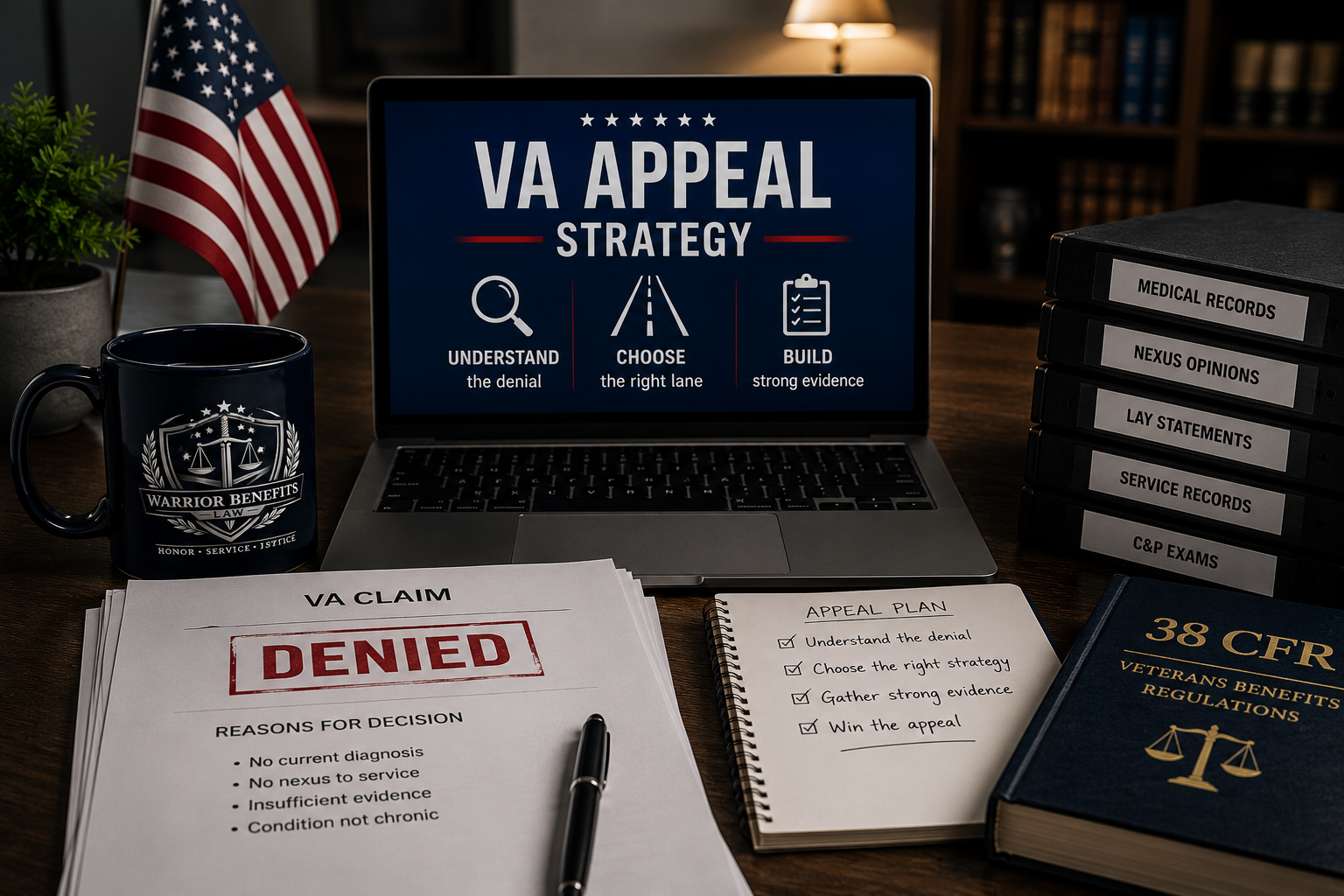
How to Win a VA Appeal by Choosing the Right Strategy
Winning a VA appeal usually starts with understanding the denial, choosing the right review lane, and building focused evidence that answers the reason VA denied the claim.
Read article
Why Do Many Veterans Miss Out on VA Benefits?
Many veterans miss out on VA benefits because they wait too long, file without the right evidence, overlook secondary conditions, or choose the wrong appeal lane after a denial.
Read article
Top Mistakes Veterans Make After a VA Denial
After a VA denial, the next move matters. The most common mistakes involve missing deadlines, choosing the wrong review lane, sending unfocused evidence, and ignoring weak exams.
Read article
Yorktown and Hampton Roads Veterans: What to Do After a VA Disability Denial
If VA denied your disability claim or assigned a lower rating than expected, the next step matters. Here is what Veterans in Yorktown, Newport News, Hampton Roads, and across Virginia should know before choosing an appeal lane.
Read article
Why Warrior Benefits Law Takes a Different Approach to VA Disability Appeals
Veterans have many choices after a VA denial. Warrior Benefits Law combines firsthand military and VA claims experience with VA-accredited, attorney-led strategy, focused evidence development, and honest guidance.
Read article