
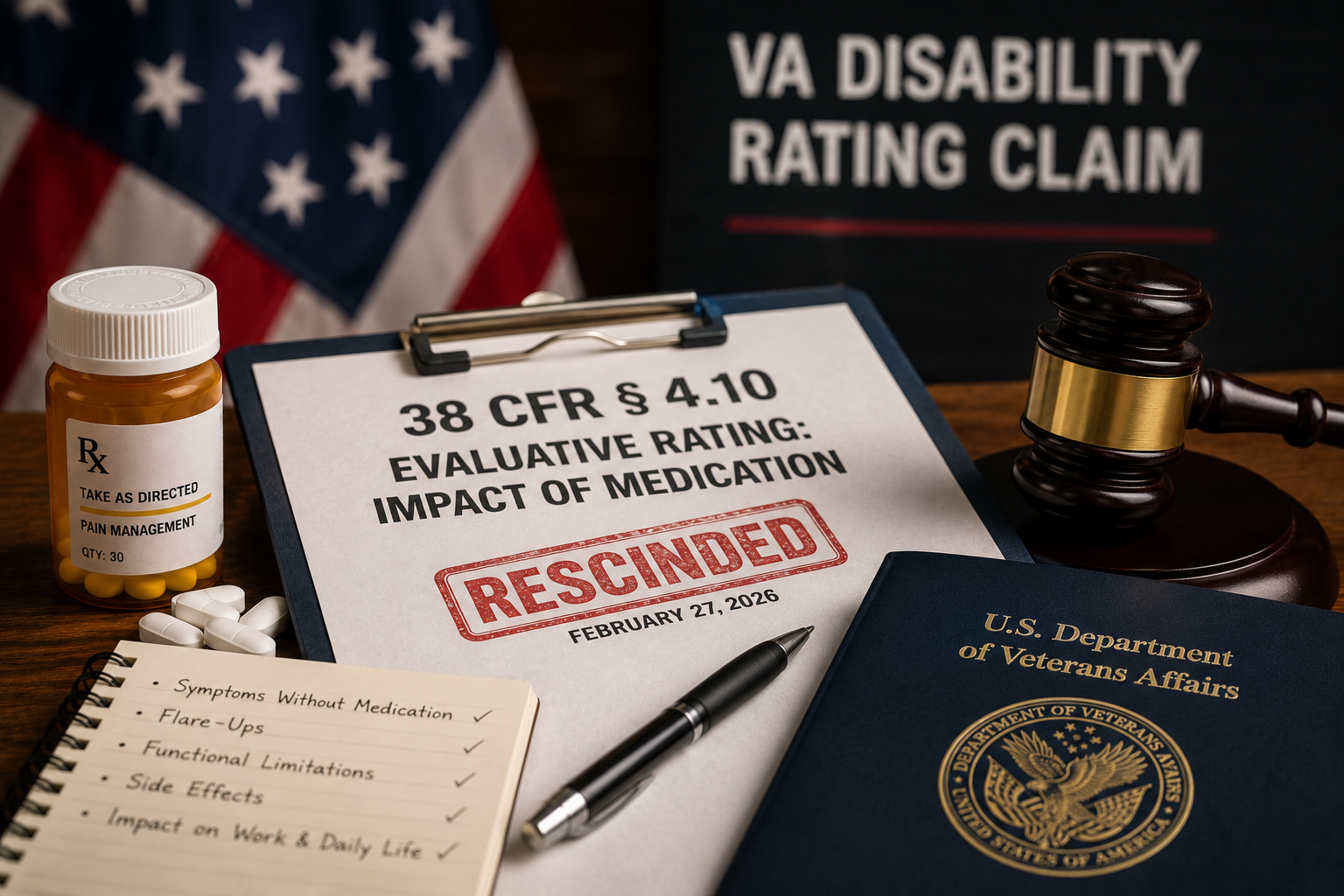
How Medication Can Affect a VA Disability Rating After the 2026 Reversal
For ten days in February 2026, VA disability law changed in a way that could have affected how Veterans taking medication were evaluated.
Then VA reversed course.
On February 17, 2026, the Department of Veterans Affairs issued an interim final rule called “Evaluative Rating: Impact of Medication.” The rule amended 38 C.F.R. § 4.10 and directed examiners to evaluate a disability at the level of impairment the Veteran experienced while benefiting from medication or other treatment.
If medication reduced pain, increased movement, stabilized mental health symptoms, or otherwise improved functioning, the new rule said the rating would be based on that improved level.
Veterans organizations and advocates immediately raised concerns. On February 27, 2026, VA formally rescinded the rule and restored the prior version of § 4.10.
The reversal was important, but it did not answer every legal question.
Veterans still need to understand how medication may affect a C&P examination, a disability rating, and an appeal.
What VA Tried to Change
The February 17 rule added two significant sentences to 38 C.F.R. § 4.10.
The new language stated that an examiner would not estimate or discount improvements caused by medication or treatment. It also stated that if treatment lowered the level of disability, VA would assign the rating based on that lowered level.
In practical terms, VA wanted to evaluate Veterans as they appeared while receiving treatment.
Imagine a Veteran with a service-connected back condition. Without medication, the Veteran may have severe pain, limited movement, disrupted sleep, and difficulty working. After taking prescribed medication, the Veteran may be able to move more freely for several hours.
Under the February 17 rule, VA could focus on the improved, medicated condition when determining the rating.
The same concern could arise with mental health medication, migraine medication, injections, nerve-pain medication, anti-inflammatory drugs, muscle relaxers, or other forms of treatment.
Why VA Issued the Rule
VA said it issued the rule in response to a 2025 decision from the U.S. Court of Appeals for Veterans Claims called Ingram v. Collins, 38 Vet. App. 130 (2025).
According to VA’s Federal Register explanation, Ingram involved ratings for service-connected musculoskeletal disabilities based on limitation of motion.
The Court held that VA had to address the beneficial effects of medication when the applicable diagnostic codes did not expressly account for medication. If the evidence did not reveal the disability’s baseline severity without those beneficial effects, VA could be required to obtain additional information.
VA strongly disagreed with that approach.
The Department argued that the decision could affect more than 500 diagnostic codes and require additional development in more than 350,000 pending claims. VA also argued that examiners could be forced to speculate about how a Veteran might function without treatment.
To prevent that result, VA used an interim final rule to change § 4.10 immediately.
The Earlier Cases Behind Ingram
Ingram did not appear out of nowhere.
The dispute developed through several Veterans Court decisions.
Jones v. Shinseki
In Jones v. Shinseki, 26 Vet. App. 56 (2012), the Court held that when a diagnostic code does not contemplate medication, the Board may not deny a higher rating based on the beneficial effects of medication.
The basic reasoning was that VA cannot add a medication-based restriction to rating criteria when the regulation itself does not include one.
McCarroll v. McDonald
In McCarroll v. McDonald, 28 Vet. App. 267 (2016), the Court explained an important limit.
When the diagnostic code itself expressly addresses medication, VA may consider medication because it is already part of the rating criteria.
That distinction remains important.
The legal analysis may be different depending on whether the diagnostic code:
- expressly mentions medication or treatment,
- includes medication use as part of a rating level, or
- says nothing about medication at all.
Ingram v. Collins
Ingram applied the medication-effects issue in the context of musculoskeletal ratings.
The Court concluded that VA could not simply rely on the Veteran’s improved, medicated presentation without addressing what the disability would look like after discounting the beneficial effects of medication.
VA responded by attempting to change the governing regulation.
The Backlash
The February 17 rule drew immediate concern from Veterans and Veterans Service Organizations.
Critics argued that the rule could penalize Veterans for following prescribed treatment.
A Veteran should not appear less disabled simply because medication temporarily makes a serious condition more manageable. Treatment may reduce symptoms without curing the underlying injury or disease.
Critics also worried that the rule could create a dangerous incentive. Veterans should never feel pressure to stop medication, skip treatment, or appear at a C&P examination without appropriate medical care in order to prove the severity of a disability.
The rule also took effect before the public had an opportunity to comment. VA invoked the Administrative Procedure Act’s good-cause exception and opened a comment period after implementation.
The reaction was swift.
VA Formally Rescinded the Rule
On February 27, 2026, VA published a final rule rescinding the interim final rule.
VA restored the previous text of 38 C.F.R. § 4.10 and stated that the rescission was effective immediately.
In explaining the reversal, VA acknowledged that stakeholders had expressed uncertainty about the rule’s effect on claims. VA stated that leaving the rule in place could undermine confidence in the benefits system.
That was an important reversal.
The current version of § 4.10 once again focuses generally on a Veteran’s ability to function under the ordinary conditions of daily life, including employment. It does not contain the February 17 language directing VA to rate every disability at the lower level produced by medication or treatment.
What the Rescission Did Not Decide
The rescission restored the prior regulation, but it did not end the legal debate.
VA expressly stated that the rescission did not resolve the legal questions before the courts. It restored the status quo while those questions remained unsettled.
That means Veterans should be cautious about overly broad statements such as:
- VA must always rate every condition as though the Veteran takes no medication.
- Medication can never affect a disability rating.
- Every Veteran taking medication is automatically entitled to a higher rating.
- The rescission automatically reopens or increases prior ratings.
None of those statements is universally correct.
The applicable diagnostic code, medical evidence, claim history, examination findings, and procedural posture still matter.
What the Current Rule Means
The current version of 38 C.F.R. § 4.10 directs VA to evaluate functional impairment under the ordinary conditions of daily life, including employment.
The regulation requires an examiner to describe how the disability affects the Veteran’s ordinary activities.
At the same time, the Jones, McCarroll, and Ingram decisions remain central to the medication analysis.
A simplified way to understand the issue is:
- If the diagnostic code expressly accounts for medication, medication may be part of the rating analysis.
- If the diagnostic code is silent about medication, VA generally should not add the beneficial effects of medication as an unwritten reason to deny a higher rating.
- In musculoskeletal cases affected by Ingram, VA may need evidence addressing the underlying severity when medication improves the Veteran’s presentation.
- The precise outcome depends on the diagnostic code and the evidence in the individual record.
The Rescission Does Not Automatically Increase Ratings
The February 27 reversal did not automatically raise anyone’s disability rating.
It also did not automatically reopen previously denied claims.
A Veteran still needs evidence showing that the disability meets the criteria for a higher rating.
That evidence may include:
- range-of-motion findings,
- painful motion,
- flare-ups,
- functional loss,
- frequency and duration of symptoms,
- work limitations,
- missed work,
- sleep disruption,
- treatment records,
- medication history,
- side effects,
- lay statements, and
- medical opinions.
The rescission removes the February 17 regulatory language. It does not eliminate the need to prove the severity of the disability.
What Veterans Should Say During a C&P Exam
Veterans should be honest and specific during a compensation and pension examination.
Do not simply say, “My medication helps.”
Explain the full picture.
A Veteran may need to describe:
- what symptoms existed before treatment,
- which symptoms improve after medication,
- which symptoms remain,
- how long the medication provides relief,
- whether symptoms return before the next dose,
- whether breakthrough symptoms occur,
- how often flare-ups happen,
- what activities remain difficult,
- whether medication causes fatigue, dizziness, confusion, stomach problems, or other side effects,
- and how the condition affects work and ordinary daily life.
The examiner should understand both the benefit and the limitations of treatment.
Medication that reduces pain from a level of nine to a level of six has not eliminated the disability. A medication that works for four hours does not necessarily describe the Veteran’s functioning during the rest of the day.
Do Not Stop Medication for an Examination
Veterans should never stop, reduce, or change prescribed medication merely to make symptoms appear worse during a C&P exam.
That can be medically dangerous.
It may also create credibility problems and interfere with treatment.
The safer approach is to continue following medical advice and make sure the record accurately documents:
- the condition before treatment,
- the response to treatment,
- remaining symptoms,
- medication side effects,
- breakthrough symptoms,
- flare-ups, and
- functional limitations.
A treating provider may be able to document this history more clearly than a one-time examiner.
Evidence That May Help
When medication significantly affects a disability, useful evidence may include:
- pharmacy records,
- prescribing-provider notes,
- pain-management records,
- physical therapy records,
- mental health treatment notes,
- headache or symptom logs,
- records showing dosage increases,
- reports of medication side effects,
- statements from spouses or family members,
- employment attendance records,
- and statements explaining what happens when the medication wears off.
Lay statements can be especially helpful.
A spouse may observe that the Veteran can function briefly after medication but becomes unable to complete tasks later in the day. A coworker may observe missed work, physical limitations, or reduced concentration. The Veteran may describe the difference between temporary symptom relief and actual functional capacity.
Warning Signs in a VA Decision
A medication issue may deserve closer review if the decision says:
- the condition is controlled by medication,
- symptoms are stable only because of treatment,
- a higher rating is denied because medication provides relief,
- the examiner did not discuss what symptoms remain,
- the examiner did not address flare-ups or breakthrough symptoms,
- the diagnostic code does not mention medication,
- or VA relied on the brief February 17 version of § 4.10.
That does not automatically mean the decision is wrong.
But it may identify an issue that should be reviewed.
What About Decisions Issued During the Ten-Day Window?
The interim rule was in effect from February 17 through February 26, 2026, before the rescission became effective on February 27.
If a rating decision, C&P opinion, or Board decision appears to rely on the rescinded medication language, the Veteran should review the decision carefully.
Relevant questions may include:
- Did VA cite the temporary version of § 4.10?
- Did the examiner rate the disability only at its medicated level?
- Did VA disregard evidence of underlying severity?
- Does the diagnostic code expressly mention medication?
- Was the rule in effect when the relevant decision was made?
- Was the decision still appealable when the rule was rescinded?
The existence of the rescinded rule does not create an automatic win. But it may be an important issue in the appeal.
Choosing an Appeal Option
If VA denied a higher rating or assigned a rating that does not reflect the disability’s true severity, the next step depends on what went wrong.
A Supplemental Claim may make sense when new and relevant evidence is needed, such as treatment records, a medical opinion, or a statement addressing the effects of medication.
A Higher-Level Review may be appropriate when the necessary evidence was already in the file but VA misapplied the law or overlooked favorable evidence.
A Board Appeal may be appropriate when the case requires review by a Veterans Law Judge or presents a more complex legal issue.
Veterans generally should not choose a review lane until they identify the reason the decision may be wrong.
Bottom Line
VA’s February 2026 medication rule lasted only ten days.
The rule would have directed examiners to rate disabilities at the lower level produced by medication or treatment, even when the applicable diagnostic code did not mention medication.
After immediate concern from Veterans and advocates, VA rescinded the rule and restored the prior text of 38 C.F.R. § 4.10.
But the legal issue did not disappear.
The effect of medication on a VA rating still depends on the diagnostic code, the medical evidence, the Veteran’s functional limitations, and the developing law under Jones, McCarroll, and Ingram.
Veterans should not stop treatment to prove a claim.
They should build a clear record showing what the medication improves, what symptoms remain, how long the relief lasts, what side effects occur, and how the condition affects work and everyday life.
If VA denied a higher rating because medication controls the condition, read the decision carefully. The answer may depend on language VA never addressed.
This article is for general information only and is not legal or medical advice. Reading this article or contacting Warrior Benefits Law does not create an attorney-client relationship unless we agree to representation in writing.
Sources
- Federal Register: Evaluative Rating—Impact of Medication, February 17, 2026
- Federal Register: Rescission of Interim Final Rule, February 27, 2026
- Electronic Code of Federal Regulations: 38 C.F.R. § 4.10
- Ingram v. Collins, 38 Vet. App. 130 (2025)
- Jones v. Shinseki, 26 Vet. App. 56 (2012)
- McCarroll v. McDonald, 28 Vet. App. 267 (2016)
- VA: Decision Reviews and Appeals