VA Launches MDMA-Assisted Therapy Trial for Veterans With PTSD and Alcohol Use Disorder
The Department of Veterans Affairs has launched a new clinical trial studying MDMA-assisted therapy for Veterans living with posttraumatic stress disorder (PTSD) and alcohol use disorder (AUD).
This is one of the more significant Veteran mental health research stories of the year.
For years, Veterans, clinicians, and researchers have looked for better treatment options for severe PTSD, especially for Veterans who continue to struggle after trying traditional treatment. The new VA trial reflects growing national interest in whether carefully supervised psychedelic-assisted therapy may help some patients with serious mental health conditions.
At the same time, VA is being careful about how it presents the research. This is not approved routine treatment. It is a controlled clinical trial.
That distinction matters.
What VA Announced
On May 26, 2026, VA announced a new clinical trial titled:
“A Randomized Controlled Trial of MDMA-Assisted Therapy for PTSD and Alcohol Use Disorder in U.S. Veterans.”
According to VA, the trial will enroll approximately 80 Veterans. The study will compare outcomes between Veterans receiving MDMA-assisted therapy and Veterans receiving the same psychotherapy with an active placebo.
The trial will take place at the VA Providence Healthcare System. Veterans will be recruited from the Providence, Rhode Island campus and from the VA Connecticut Healthcare System in West Haven, Connecticut.
VA also stated that it is coordinating with the U.S. Food and Drug Administration (FDA) and intends to share trial data with FDA.
That makes this more than a small research project. It is part of a larger effort to study whether psychedelic-assisted therapy may have a role in treating severe mental health conditions in a safe, controlled, medical setting.
What Is MDMA-Assisted Therapy?
MDMA-assisted therapy is not the same thing as simply taking MDMA.
VA’s National Center for PTSD explains that MDMA-assisted therapy involves using MDMA as an adjunct to psychotherapy. In plain English, that means the medication is paired with structured talk therapy in a controlled clinical environment.
Researchers are interested in MDMA because it may reduce fear, increase openness, and improve emotional engagement during therapy. The theory is that these effects may help some patients process trauma more effectively when the medication is combined with psychotherapy.
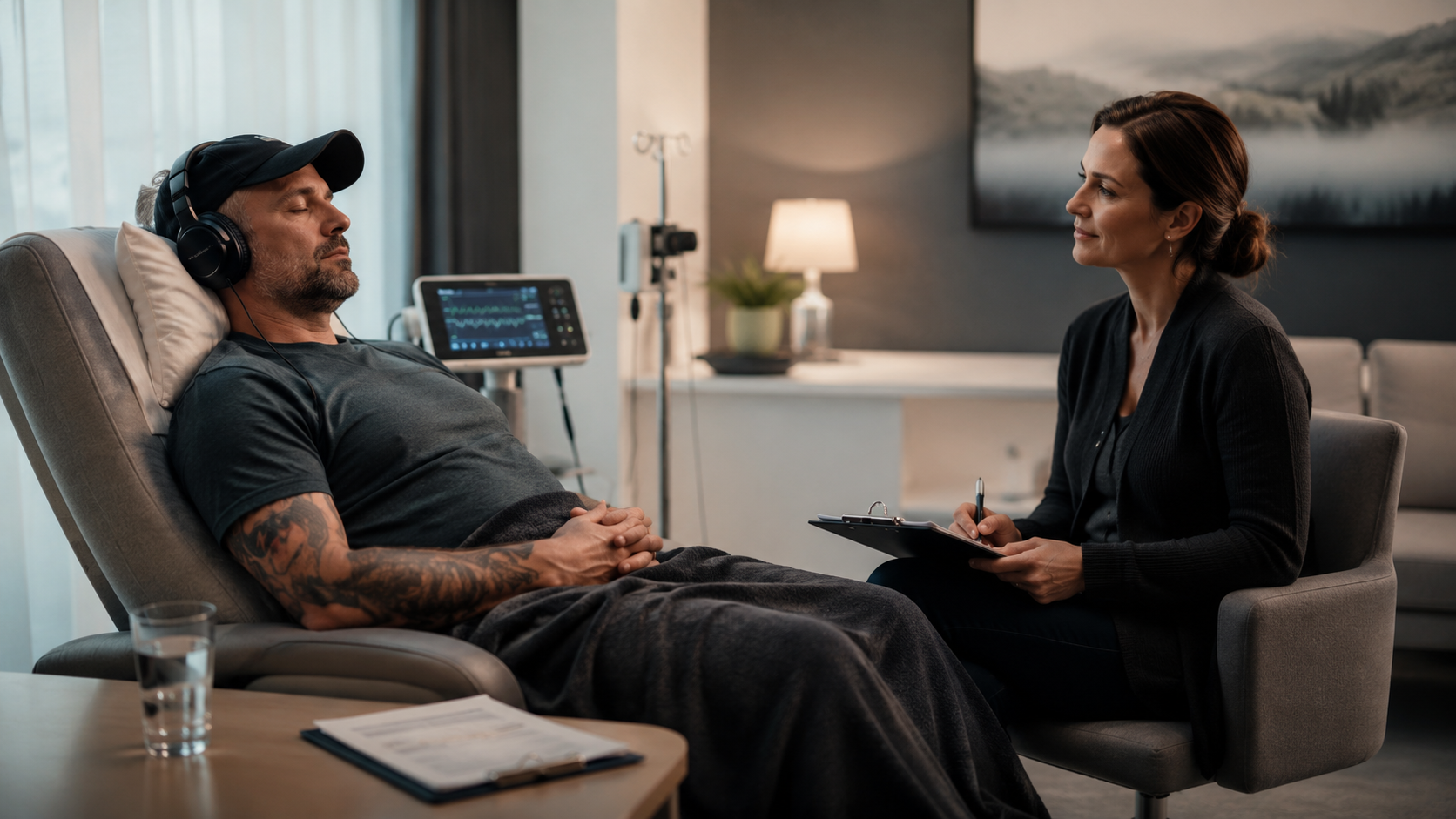
The treatment model generally involves:
- preparation sessions before medication sessions,
- medication sessions in a controlled clinical setting,
- trained therapists,
- careful medical monitoring,
- and follow-up integration sessions after the medication sessions.
The therapy is not just the drug. It is the drug plus the therapeutic setting, clinical supervision, and structured psychotherapy.
Why VA Is Studying PTSD and Alcohol Use Disorder Together
This trial is especially important because it focuses on Veterans with both PTSD and alcohol use disorder.
That combination is common and difficult.
Some Veterans use alcohol to cope with nightmares, anxiety, sleep problems, hypervigilance, isolation, guilt, anger, depression, or intrusive memories. Over time, alcohol can become part of the problem. It may worsen sleep, strain relationships, affect work, increase health risks, and make mental health treatment harder.
When PTSD and alcohol use disorder appear together, treatment can be more complicated than treating either condition alone.
That is why this trial matters. It is aimed at a real-world problem many Veterans face: trauma symptoms and alcohol misuse feeding into each other.
Why This Is a Big Story
This trial is a big story because it shows VA is willing to study innovative mental health treatments inside the VA system.
VA stated that it is also involved in 19 other active clinical trials focused on psychedelic therapies for mental health conditions, supported by more than $23 million in external funding.
That does not mean psychedelic-assisted therapy is now standard VA treatment.
It means VA is studying the issue seriously, under research protocols, with safety controls and FDA coordination.
For Veterans and families who have watched PTSD treatment fail or only partially work, that research matters.
What the Trial Does Not Mean
It is important not to overstate this announcement.
The trial does not mean MDMA is now approved as routine treatment at VA.
It does not mean every Veteran with PTSD or alcohol use disorder can receive MDMA-assisted therapy.
It does not mean Veterans should try to self-medicate.
VA specifically warns that clinical use of psychedelic therapies outside research will only be considered after FDA approval. VA also strongly discourages self-medicating or trying to replace proven mental health treatment with psychedelics or any unprescribed substances.
That warning is important.
A controlled clinical trial is very different from recreational drug use or unsupervised self-treatment. In a research setting, the medication is pharmaceutical grade, the setting is controlled, safety protocols are in place, and trained clinicians are present.
Why Researchers Think MDMA May Help
VA’s National Center for PTSD explains that MDMA may reduce fear, increase social engagement, increase openness, increase empathy and compassion, and increase disclosure of emotional content.
Those effects may help some patients engage with difficult trauma memories during therapy.
The goal is not to erase memory. The goal is to help the patient process traumatic material in a therapeutic setting with less avoidance and fear.
That is why the psychotherapy component is so important. MDMA-assisted therapy is being studied as a way to enhance therapy, not replace it.
What the Research Still Needs to Answer
The research is promising, but there are still important questions.
VA’s National Center for PTSD notes that psychedelic research can be difficult to study because the strong physical and psychological effects of psychedelics can make it hard to keep participants and researchers fully blinded. If a participant knows or strongly suspects they received the active drug, expectations can affect outcomes.
VA also notes that more Veteran-specific research is needed.
That is another reason this trial matters. It is focused on U.S. Veterans with PTSD and alcohol use disorder, which may help researchers better understand how this treatment model works in the Veteran population.
What Veterans Should Know
Veterans reading about this should understand a few key points:
- This is a clinical trial, not standard VA treatment.
- The study focuses on Veterans with PTSD and alcohol use disorder.
- The trial plans to enroll about 80 Veterans.
- The trial involves structured psychotherapy and medical monitoring.
- VA is coordinating with FDA.
- The trial is registered on ClinicalTrials.gov.
- VA discourages self-medication with psychedelics or unprescribed substances.
Veterans interested in this topic should use official VA and ClinicalTrials.gov resources and talk with qualified health care providers.
Veterans Should Not Wait to Get Help
Even if this research becomes important in the future, Veterans should not wait for experimental treatments before seeking help.
VA already offers evidence-based treatments for PTSD, substance use disorders, depression, anxiety, and related mental health conditions.
Veterans struggling with PTSD, alcohol misuse, suicidal thoughts, severe depression, panic, isolation, or unsafe behavior should reach out now.
If a Veteran is in crisis, or if someone is worried about a Veteran, the Veterans Crisis Line is available by calling 988 and pressing 1, texting 838255, or using the online chat at VeteransCrisisLine.net.
A Light VA Disability Angle
This story is mainly about treatment and research, not disability compensation.
But it does connect to VA disability claims in one important way: mental health treatment records can matter.
For Veterans pursuing service connection, an increased rating, or an appeal involving PTSD, alcohol use disorder, depression, anxiety, or other mental health symptoms, treatment records may help document:
- diagnosis,
- symptom severity,
- treatment history,
- medication changes,
- occupational impairment,
- social impairment,
- sleep problems,
- substance use complications,
- crisis symptoms,
- hospitalizations,
- and how the condition affects daily life.
The announcement of this trial does not change VA’s rating criteria for PTSD. But it does show that VA recognizes the seriousness of trauma-related mental health conditions and the need for better treatment options.
Bottom Line
VA’s new MDMA-assisted therapy trial is an important mental health research development for Veterans.
The trial will study whether MDMA-assisted therapy can help Veterans living with PTSD and alcohol use disorder. It will take place in a controlled clinical setting, with structured psychotherapy, safety protocols, and FDA coordination.
The research is worth watching.
But Veterans should also be careful. This is not approved routine treatment, and VA strongly discourages self-medicating or replacing evidence-based care with unprescribed psychedelics.
For Veterans and families dealing with PTSD or alcohol misuse, the practical message is simple: new research is underway, but help is available now.
This article is for general information only and is not legal advice or medical advice. Reading this article or contacting our office does not create an attorney-client relationship unless we agree to representation in writing.
Sources
- VA: VA launches MDMA-assisted mental health therapy trial
- VA Research: MDMA-Assisted Therapy for Veterans with PTSD and Alcohol Use Disorder
- ClinicalTrials.gov: MDMA-Assisted Therapy for Veterans With PTSD and Alcohol Use Disorder
- VA National Center for PTSD: Psychedelic-Assisted Therapy for PTSD
- VA National Center for PTSD: MDMA-Assisted Therapy for PTSD
- Veterans Crisis Line