
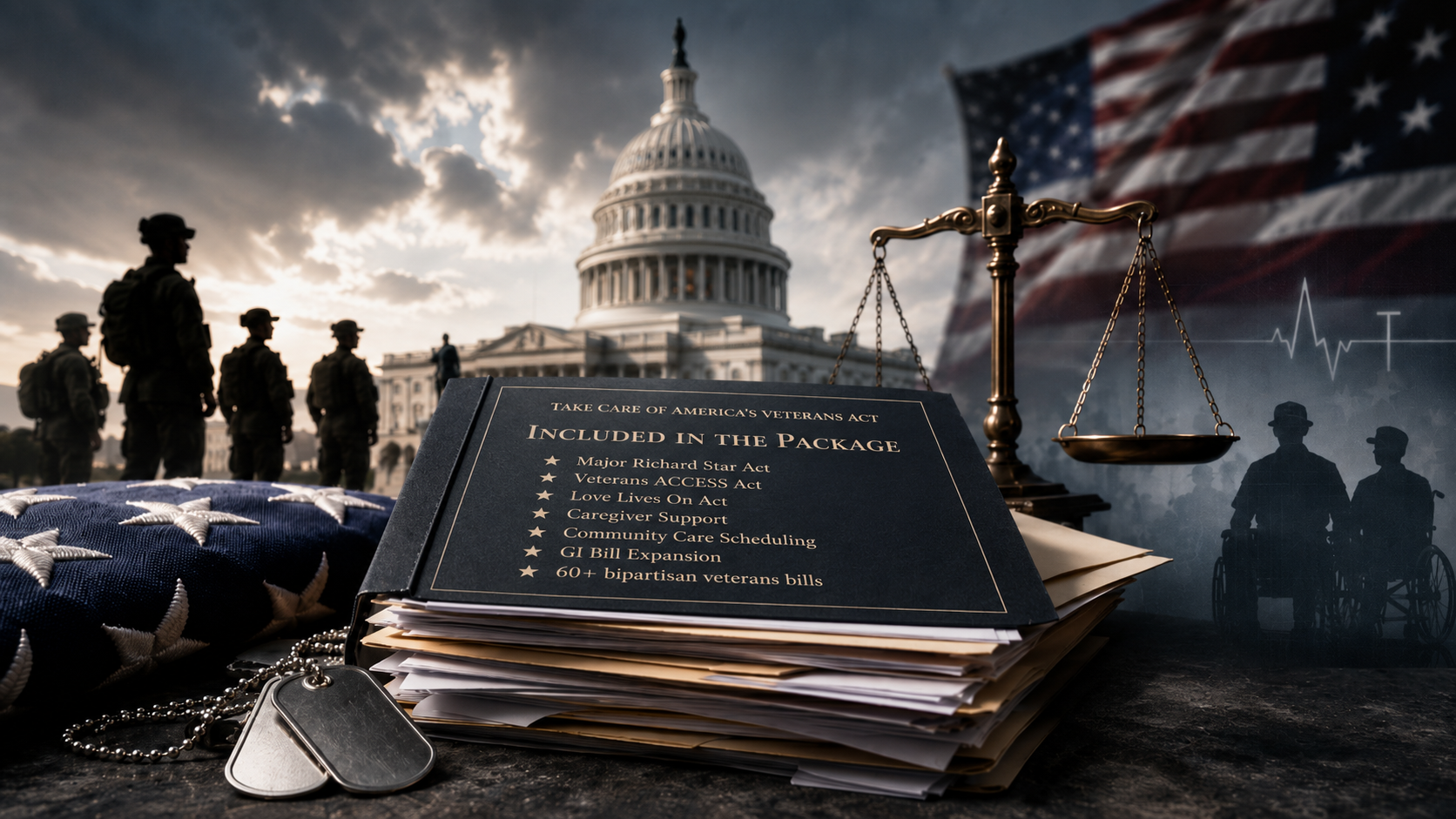
Take Care of America’s Veterans Act Update: Why the Fight Is Getting Louder
The Take Care of America’s Veterans Act has quickly become one of the biggest Veterans policy fights in Washington.
When the bill was first introduced, the headline was simple: a sweeping package of more than 60 Veterans bills, including a long-awaited path forward for the Major Richard Star Act.
That alone made the bill significant.
But since its introduction, the debate has grown louder because the package does not only expand benefits. It also raises a hard question about how Congress plans to pay for those benefits.
That is where the fight is now.
What Happened
On June 10, 2026, House Veterans’ Affairs Committee Chairman Mike Bost and Senate Veterans’ Affairs Committee Chairman Jerry Moran announced the Take Care of America’s Veterans Act, describing it as a comprehensive Veterans package intended to move the Major Richard Star Act and more than 60 bipartisan Veterans bills.
The official House Veterans’ Affairs announcement described the package as a negotiated House-Senate effort to pass major Veterans legislation in the coming weeks.
The bill was introduced as H.R. 9237 in the House and S. 4744 in the Senate.
Supporters framed it as a major “America 250” Veterans package, designed to modernize VA care, expand benefits, reduce bureaucracy, improve health care access, and deliver long-stalled reforms.
In short, the bill was introduced as a major Veterans reform vehicle.
Why the Major Richard Star Act Is at the Center
One of the biggest pieces of the package is the Major Richard Star Act.
Under current law, some combat-injured Veterans who were medically retired before reaching 20 years of service are prevented from receiving both full military retirement pay and VA disability compensation.
Supporters have called that rule unfair for years.
The House Veterans’ Affairs announcement says the Major Richard Star Act would eliminate that gap and allow about 54,000 combat-wounded Veterans to receive both forms of earned compensation.
That is a major reason the package has support.
Many Veterans organizations and lawmakers have long supported the Major Richard Star Act. For combat-injured retirees, the issue is not abstract. It is about whether they can receive retirement pay they earned and disability compensation for injuries connected to service.
That part of the bill is widely seen as overdue.
What Else Is in the Package?
This is not just a Major Richard Star Act bill.
The official House Veterans’ Affairs announcement lists a broad range of priorities included in the negotiated package. Those include proposals connected to:
- the Veterans’ ACCESS Act,
- benefits increases for severely disabled Veterans and Gold Star families,
- the Love Lives On Act,
- caregiver support,
- Veterans disability benefits and appeals modernization,
- GI Bill benefits expansion,
- transition assistance,
- community care scheduling improvements,
- VA technology and IT modernization,
- traumatic brain injury research and treatment,
- VA contracting and procurement reform,
- and changes to VA facility construction and leasing.
Rep. Tom Barrett’s office also highlighted several bills folded into the package, including proposals related to clearer VA claims communications, vehicle modifications for disabled Veterans, accessible transportation, faster digital delivery of VA communications, community care scheduling, and home affordability for Guard and Reserve members.
That is why the bill is so important.
It is not a single-issue bill. It is a broad Veterans package touching disability benefits, health care, survivors, caregivers, VA systems, transportation, housing, and the way VA communicates with Veterans.
Why the Debate Escalated
The controversy is not mainly about whether combat-injured Veterans should receive better support.
The controversy is about the offsets.
The Veterans of Foreign Wars publicly opposed the bill as currently drafted, arguing that the package would pay for expanded benefits by changing how VA rates future claims involving tinnitus and obstructive sleep apnea.
VFW said the bill would offset the cost of expanding benefits for combat-injured Veterans by cutting disability compensation and health care access for future generations of disabled Veterans.
That statement turned the bill from a major Veterans reform package into a major Veterans benefits fight.
The Central Question
The central question is this:
Should Congress expand some Veterans benefits by reducing or limiting other Veterans benefits in the future?
That is the fight.
Supporters argue the package finally creates a path forward for long-delayed reforms, especially the Major Richard Star Act.
Critics argue that Congress should not fund those reforms by changing the VA rating schedule for common service-connected conditions such as tinnitus and sleep apnea.
Both sides understand that the stakes are high.
What VFW Is Saying
The VFW has taken a strong position against the bill as currently drafted.
VFW stated that it opposes provisions that would ask future disabled Veterans to bear the cost of expanding benefits through changes to the VA rating schedule for tinnitus and obstructive sleep apnea. VFW also cited VA estimates that the changes could reduce disability compensation payments by about $57 billion over ten years and affect up to 1.5 million Veterans.
The VFW’s position is not that every part of the bill is bad.
The position is that the funding mechanism is unacceptable.
In plain language, VFW is saying: pass the good parts, but do not send the bill to future disabled Veterans.
What Democrats and DAV Are Saying
House Veterans’ Affairs Ranking Member Mark Takano also criticized the package, arguing that Congress is close to forcing a clean vote on the Major Richard Star Act through a discharge petition and that the new package distracts from that effort.
Takano’s statement framed the issue as a choice between passing the Major Richard Star Act cleanly or accepting a broader package with controversial offsets.
The same statement also quoted opposition from Veterans Service Organizations, including VFW and DAV.
DAV’s criticism is especially important because it acknowledged that the package includes priorities DAV supports, including the Major Richard Star Act, increases for survivor benefits, increases for catastrophically disabled Veterans’ Special Monthly Compensation payments, expanded caregiver support, prosthetic improvements, and other provisions.
But DAV still opposed the funding mechanism, calling it a “poison pill.”
That is the tension at the heart of the bill.
The package includes real benefits. The fight is over the price.
Why Sleep Apnea and Tinnitus Became the Flashpoint
Sleep apnea and tinnitus became the flashpoint because they are two of the most common VA disability issues.
Tinnitus is frequently claimed by Veterans exposed to weapons, aircraft, engines, explosions, machinery, and other military noise. Sleep apnea is also common in the Veteran population and is often claimed directly or as secondary to other service-connected conditions.
These conditions may sound narrow to someone outside the VA system.
They are not narrow to Veterans.
A change to how VA rates these conditions could affect future claims, secondary claims, increased-rating claims, combined ratings, and long-term planning for Veterans who have not yet filed or whose claims are still developing.
That is why the offset debate has become so intense.
What Has Changed Since the Bill Was Introduced?
The biggest development is not that the bill has passed.
The biggest development is that the battle lines have become clearer.
Supporters are emphasizing:
- more than 60 bipartisan bills,
- a path forward for the Major Richard Star Act,
- expanded support for combat-injured retirees,
- improved VA care,
- better claims communications,
- caregiver support,
- survivor benefits,
- transportation and accessibility,
- health care access,
- and modernization of VA systems.
Critics are emphasizing:
- controversial disability-rating offsets,
- potential reductions for future Veterans,
- sleep apnea and tinnitus rating changes,
- the risk of using disability compensation as a budget tool,
- and the possibility of passing the Major Richard Star Act without tying it to benefit cuts.
That is where the debate stands now.
What Veterans Should Watch Next
Veterans should watch several things closely.
First, watch whether lawmakers change the offset language.
If the sleep apnea and tinnitus provisions are removed or rewritten, the political picture could change quickly.
Second, watch whether Congress moves the package as one large bill or separates the Major Richard Star Act from the broader package.
That is a major strategic question.
Third, watch Veterans Service Organizations.
Groups like VFW, DAV, American Legion, IAVA, Wounded Warrior Project, MOAA, and others can shape the debate. If major organizations remain opposed to the funding mechanism, lawmakers may feel pressure to amend the bill.
Fourth, watch the timeline.
Supporters have talked about moving the bill in the coming weeks. But controversial Veterans legislation can change quickly through negotiation, amendment, committee action, or pressure from advocacy groups.
Finally, watch the final text.
A bill as introduced is not always the bill that passes.
What This Means for Veterans Right Now
Veterans should not panic.
As of this update, this is proposed legislation and political debate. It is not a final law changing anyone’s benefits today.
But Veterans should pay attention.
If you have pending claims involving tinnitus, sleep apnea, or secondary conditions, stay organized. Keep copies of decision letters, medical records, sleep studies, audiology records, lay statements, and any evidence connecting the condition to service.
If you are already rated, keep copies of your rating decisions and benefit summary letters.
If you are thinking about filing, understand the current rules and monitor whether Congress changes the rating schedule in the future.
The key is to stay informed without overreacting.
The Bigger Picture
The Take Care of America’s Veterans Act is important because it shows where Veterans policy may be heading.
Congress wants to do more in several areas. Combat-injured retirees need relief. Catastrophically disabled Veterans and Gold Star families need support. Caregivers need help. VA systems need modernization. Veterans need clearer communication and better access to care.
But the fight over offsets raises a serious question:
Do Veterans benefits need to be paid for by reducing other Veterans benefits?
That question will not disappear with this bill.
It may shape future Veterans legislation for years.
Bottom Line
The Take Care of America’s Veterans Act remains one of the most important Veterans policy stories of the moment.
The bill is significant because it combines more than 60 Veterans proposals, includes the Major Richard Star Act, and would touch health care, disability benefits, survivors, caregivers, transportation, housing, VA technology, and appeals modernization.
But the controversy has only grown since introduction.
Supporters see the bill as a historic chance to move long-delayed reforms. Critics see the offset provisions as an unacceptable tradeoff that could make future disabled Veterans pay for benefits Congress should fund without cuts.
For Veterans, the best approach is to watch the bill closely, pay attention to amendments, avoid panic, and keep records organized.
The bill is bigger than sleep apnea and tinnitus.
But the debate over sleep apnea and tinnitus is the reason this bill has become one of the most important Veterans benefits fights in Washington.
This article is for general information only and is not legal advice. Reading this article or contacting Warrior Benefits Law does not create an attorney-client relationship unless we agree to representation in writing.
Sources
- House Veterans’ Affairs Committee: Chairmen Bost, Moran Introduce Comprehensive Veterans Legislation
- Rep. Tom Barrett: Barrett, Colleagues Introduce Historic Take Care of America’s Veterans Act Ahead of America 250
- VFW: VFW Strongly Opposes Disability Benefit Cuts Included in Proposed Take Care of America’s Veterans Act
- House Veterans’ Affairs Democrats: Ranking Member Takano Warns Against Republican Bid to Strip Veterans of Their Disability Benefits