
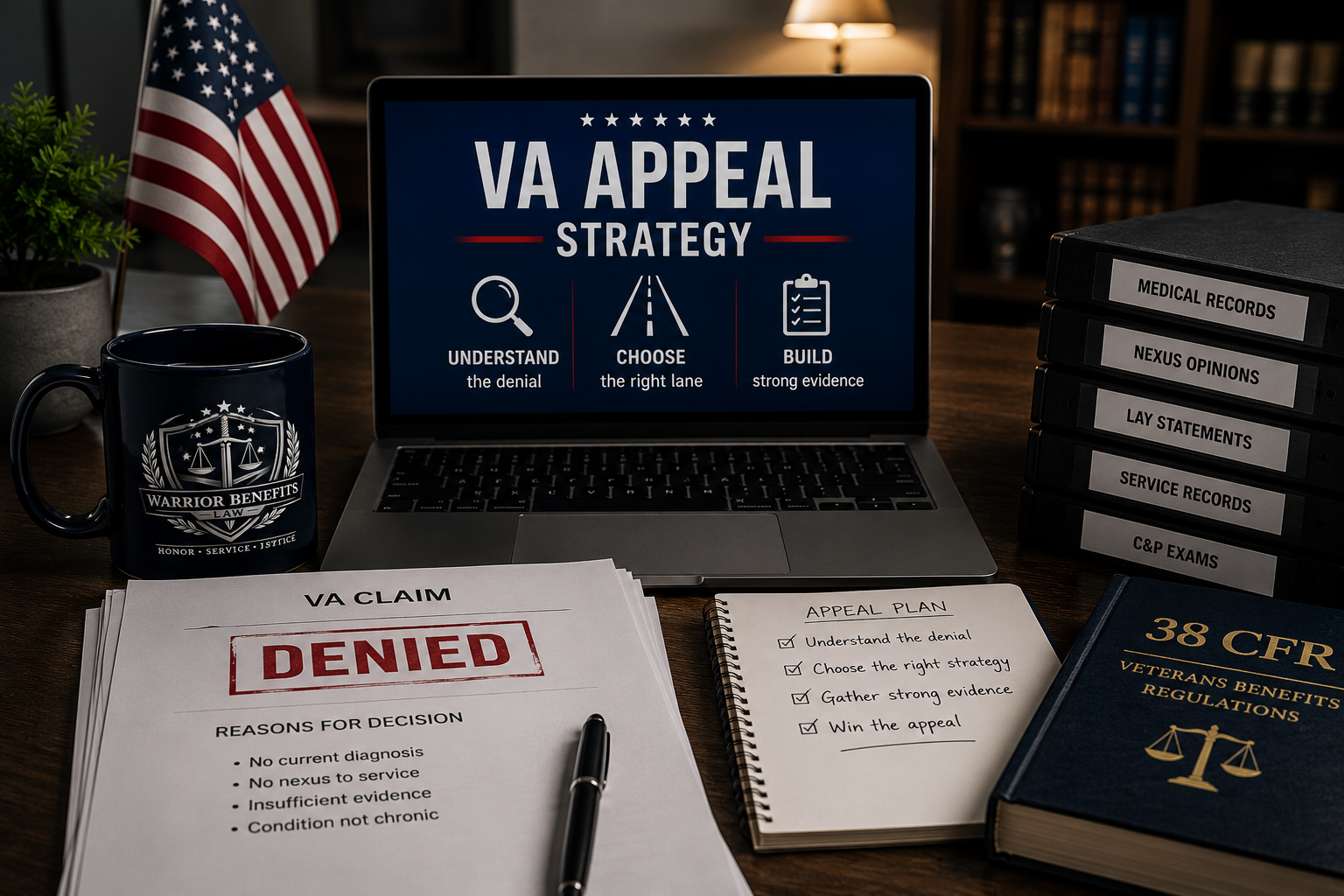
How to Win a VA Appeal
There is no single formula for winning a VA appeal.
Every case is different. Some appeals turn on missing medical records. Some turn on a weak compensation and pension exam. Some turn on whether the Veteran chose the right review lane. Others turn on whether the evidence clearly explains the connection between the Veteran’s service and the current disability.
But strong VA appeals usually have three things in common:
- The denial is understood clearly.
- The review lane matches the problem.
- The evidence is built with purpose.
A successful appeal is not just about disagreeing with VA. It is about showing why the decision was wrong and giving VA, or the Board, a clear reason to fix it.
Start With the Denial Letter
The first step is to slow down and read what VA actually said.
That may sound obvious, but many Veterans skip this step because the denial is frustrating. They know the decision feels wrong, so they immediately start thinking about what to send next.
The denial letter often reveals the missing piece.
Sometimes VA says there is no current diagnosis. Sometimes VA accepts that the Veteran has a condition but says there is no connection to service. Sometimes VA accepts service connection but assigns a rating that is too low. Sometimes the issue is the effective date. Sometimes the problem is a compensation and pension exam that overlooked important facts.
The appeal should respond to the actual reason for the denial.
A Veteran should look closely for:
- The issues VA decided
- The evidence VA reviewed
- The favorable findings
- The reason VA denied the claim
- Any negative medical opinions
- Any missing records
- Any rating criteria VA applied
- Any deadlines for review
The decision letter is not just bad news. It is the roadmap for the appeal.
Choose the Right Review Lane
VA gives Veterans several review options, including Supplemental Claim, Higher-Level Review, and Board Appeal.
The right choice depends on what went wrong.
A Supplemental Claim may make sense when the case needs new and relevant evidence. This could include a new medical opinion, updated treatment records, a buddy statement, private medical records, or other evidence that directly addresses the reason for the denial.
A Higher-Level Review may make sense when the evidence was already strong, but VA made a legal or factual error. In that lane, the Veteran generally cannot submit new evidence. The argument is that VA should have reached a different decision based on the record it already had.
A Board Appeal may make sense when the case needs review by a Veterans Law Judge, when the legal issue is more complex, or when the Veteran needs a Board docket strategy.
The mistake is choosing a lane before identifying the problem.
If the file needs evidence, a Higher-Level Review may not fix it. If the file already had the evidence and VA simply got it wrong, a Supplemental Claim may add delay without addressing the actual error. If the case needs judge-level review, the Board may be the better path.
Strategy comes first. Lane selection comes second.
Build Evidence That Answers the Real Issue
Winning appeals is rarely about sending everything.
It is about sending what matters.
A Veteran can submit hundreds of pages and still fail to answer the reason VA denied the claim. More paperwork does not always mean a stronger appeal. The best evidence is evidence that directly addresses the missing piece.
If VA denied the claim because there was no diagnosis, the appeal should focus on medical evidence showing the current condition.
If VA denied nexus, the appeal should focus on evidence connecting the condition to service.
If VA assigned a low rating, the appeal should focus on severity, frequency, functional loss, work impact, flare-ups, medication, hospitalizations, or other rating factors.
If VA relied on a weak exam, the appeal should explain why the exam is unreliable.
Useful evidence may include:
- VA medical records
- Private medical records
- Specialist reports
- Medical opinions
- Nexus letters
- Disability Benefits Questionnaires
- Lay statements
- Buddy statements
- Employment records
- Service treatment records
- Service personnel records
- Deployment records
- Prior VA decisions and examination reports
The evidence should have a job. If it does not help prove or explain something important, it may not strengthen the appeal.
Do Not Ignore Favorable Findings
Favorable findings can be important.
In many VA decisions, VA may concede certain facts even while denying the claim. For example, VA may concede that the Veteran has a current diagnosis. VA may concede that an in-service event happened. VA may concede exposure, service in a certain location, or the existence of a service-connected disability.
Those findings can help narrow the fight.
If VA has already accepted one part of the case, the appeal should not waste space re-proving what VA already conceded. The strategy should focus on what remains disputed.
A good appeal identifies what VA accepted, what VA denied, and what evidence is needed to bridge the gap.
Be Careful With Timing
Timing matters in VA appeals.
Many Veterans have one year from the date of the decision letter to choose a review option and preserve important appeal rights. Waiting too long can limit options and complicate the effective-date picture.
A Veteran does not have to panic, but the Veteran should not ignore the deadline.
A practical approach is to:
- Mark the deadline immediately.
- Read the decision letter.
- Identify the reason for denial.
- Decide whether new evidence is needed.
- Choose the review lane that fits the problem.
- File before the deadline expires.
Effective dates can be valuable. A rushed appeal can be a problem, but a late appeal can be even worse.
Use Consistency Across the Record
Strong appeals usually tell a consistent story.
That does not mean every record must use the exact same words. Medical records, lay statements, service records, and expert opinions may describe the condition differently. But the core story should make sense.
Inconsistent records can create credibility problems. If a Veteran tells one story to VA, a different story to a doctor, and another story in a lay statement, the claim becomes harder to understand.
Consistency helps VA see the case clearly.
A strong record should connect:
- What happened in service
- When symptoms began
- How symptoms continued or worsened
- What the current diagnosis is
- How the condition affects daily life and work
- Why the condition is connected to service
The clearer the story, the easier it is for VA or the Board to understand the appeal.
Know When a Hearing Helps
Some cases benefit from a hearing.
A hearing can be useful when testimony matters, when the Veteran needs to explain events that are not well documented, or when the Veteran’s personal account helps clarify the record.
But a hearing is not always the best choice.
Hearings can add time. Some appeals are better decided on a clean written record with strong medical evidence. If the issue is a medical nexus, testimony alone may not solve the problem. If the record already explains the facts well, a hearing may not add much.
The question is not whether hearings are good or bad.
The question is whether a hearing helps the specific case.
A hearing should be a strategic choice, not an automatic reaction.
Address Weak Exams Directly
Many VA appeals turn on compensation and pension exams.
If VA relied on a weak examination or unsupported medical opinion, the appeal should address that problem directly. Veterans often lose ground when they treat a flawed exam as if it were a fixed fact.
A weak exam may have problems such as:
- Ignoring the Veteran’s lay statements
- Failing to review relevant records
- Using an inaccurate factual history
- Overlooking symptoms
- Failing to discuss flare-ups
- Failing to address functional loss
- Providing a conclusion without a reasoned explanation
- Ignoring secondary service connection
- Ignoring aggravation
- Relying on the absence of treatment records without explaining why
If the exam is the reason VA denied the claim, the appeal should explain why the exam is not enough.
Match the Evidence to the Appeal Lane
The evidence strategy should match the review lane.
In a Supplemental Claim, the Veteran should submit or identify new and relevant evidence. The evidence should be targeted and tied to the reason for the prior denial.
In a Higher-Level Review, the Veteran should focus on the error VA made based on the evidence that was already in the file. This may include pointing to overlooked records, misapplied law, or internal inconsistencies in the decision.
In a Board Appeal, the Veteran should think carefully about docket choice, whether evidence will be submitted, and whether a hearing is worth the additional time.
The strongest appeals are intentional. They are not just a pile of records. They are built around the review option being used.
Do Not Forget Secondary Conditions
Some appeals become stronger when the Veteran looks at the full disability picture.
A condition may not be directly caused by service, but it may be caused or aggravated by an already service-connected disability.
Examples may include:
- A knee condition causing back or hip problems
- Chronic pain contributing to depression or sleep problems
- Tinnitus worsening sleep or anxiety
- PTSD contributing to substance use or work problems
- Medication side effects causing additional symptoms
- An altered gait causing problems in another joint
If the evidence supports secondary service connection, the appeal should explain that theory clearly.
Bottom Line
Winning a VA appeal is usually about the right combination of record review, lane selection, evidence development, and disciplined presentation.
The Veteran should start with the denial letter, identify the missing piece, choose the review lane that fits the problem, and build evidence that directly answers VA’s reason for denial.
A strong appeal does not just say VA was wrong. It shows why VA was wrong.
The more clearly the case answers the denial, the stronger the appeal becomes.
This article is for general information only and is not legal advice. Reading this article or contacting our office does not create an attorney-client relationship unless we agree to representation in writing.