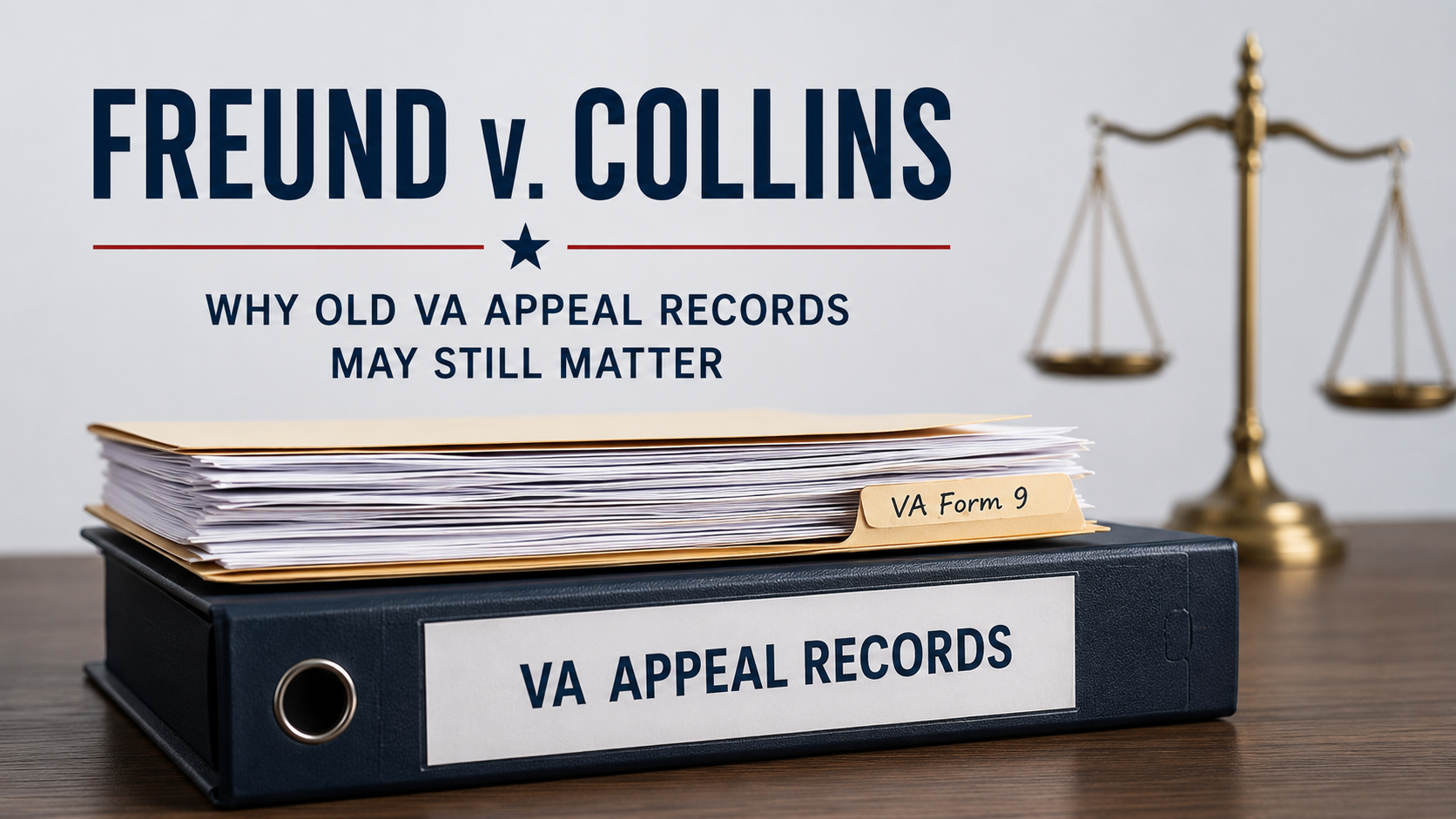
Freund v. Collins: Why Old VA Appeal Records May Still Matter
A VA appeals case called Freund v. Collins is getting attention because it involves a proposed class settlement for certain VA benefits claimants whose legacy appeals may not have been properly processed.
For many Veterans, that may sound technical.
But the bigger lesson is simple:
Old VA appeal records can still matter.
A denial letter from years ago, a Statement of the Case, a VA Form 9, a mailing receipt, a fax confirmation, or a copy of an appeal can become important if there is a dispute about whether VA properly processed the case.
Veterans should not assume that old paperwork is worthless.
What is Freund v. Collins about?
Freund v. Collins is a case before the U.S. Court of Appeals for Veterans Claims.
According to VA’s public notice, the case involves certain VA benefits claimants whose appeals were closed in VA’s legacy appeal system on the ground that a timely Substantive Appeal was not filed.
A proposed classwide settlement has been filed. The Veterans Court scheduled a fairness hearing for August 13, 2026, to consider whether the proposed settlement is fair, reasonable, and adequate.
This does not mean every old VA denial is part of the case.
It also does not mean every Veteran with an old appeal automatically gets benefits.
But it does show why appeal records and filing proof can matter years later.
What was the legacy appeal system?
Before the modern decision review system, many VA appeals moved through what is often called the legacy appeals system.
In that system, a Veteran typically had to move through several steps after a VA decision.
A simplified version looked like this:
- VA issued a rating decision.
- The Veteran filed a Notice of Disagreement.
- VA issued a Statement of the Case.
- The Veteran filed a Substantive Appeal, often using VA Form 9.
- The case could then proceed toward the Board of Veterans’ Appeals.
The Substantive Appeal step was important because it helped perfect the appeal to the Board.
If VA decided that a Substantive Appeal was not timely, the appeal could be closed.
Freund v. Collins concerns certain legacy appeals that were closed on that type of ground.
Why old VA appeal records matter
Veterans often throw away old paperwork because they assume the case is over.
That can be a mistake.
VA records can matter for:
- Appeal deadlines;
- Effective dates;
- Whether an appeal remained pending;
- Whether VA received a filing;
- Whether VA properly processed a document;
- Whether a Veteran responded on time;
- Whether a prior denial became final;
- Whether an old claim may still affect benefits today.
A single document can change the analysis.
For example, a copy of a VA Form 9 may matter. A certified mail receipt may matter. A fax confirmation may matter. A letter from VA acknowledging receipt may matter. A representative’s copy may matter.
The question is not just what the Veteran filed.
The question may also be whether the Veteran can prove it.
What is a Substantive Appeal?
In the legacy system, the Substantive Appeal was the step used to continue the appeal to the Board after VA issued a Statement of the Case.
Many Veterans used VA Form 9 for this step.
If the form was not filed on time, VA could close the appeal.
But disputes can happen.
A Veteran may believe the appeal was filed. VA may say it was not timely. Records may be incomplete. A mailing issue may exist. A representative may have kept a copy. The Veteran may have moved. VA may have used an old address. The file may contain evidence that was overlooked.
That is why the paper trail matters.
Does Freund v. Collins apply to every Veteran?
No.
Veterans should be careful not to overread the case.
VA’s notice describes a specific class involving certain legacy appeals closed during a specific time period because VA determined there was no timely Substantive Appeal, and the appeal remains closed.
That is a narrower issue than “VA denied my claim.”
A Veteran who had a modern appeal, a recent Supplemental Claim, a Higher-Level Review, a Board Appeal under the modern system, or a denial for lack of nexus may not be part of that specific class.
The official notice should be reviewed carefully.
Why this still matters even if you are not in the class
Even Veterans who are not part of Freund can learn from it.
The case shows how important appeal processing and documentation can be.
A VA claim is not just about medical evidence. It is also about procedure.
Deadlines, filing receipts, appeal forms, VA letters, address changes, and proof of submission can all matter.
Veterans should keep copies of:
- VA rating decisions;
- Notification letters;
- Notices of Disagreement;
- Statements of the Case;
- Supplemental Statements of the Case;
- VA Form 9;
- Board decisions;
- Mailing receipts;
- Fax confirmations;
- Upload confirmations;
- VA.gov screenshots;
- Representative correspondence;
- Any letter showing VA received a filing.
A Veteran may not need those records today.
But if a dispute arises later, those records may be critical.
What if an old VA appeal was closed as untimely?
If a Veteran believes an old legacy appeal was wrongly closed as untimely, the Veteran should not rely only on memory.
The Veteran should try to gather the file.
Helpful steps may include:
- Finding old VA decision letters;
- Looking for the Statement of the Case;
- Searching for a copy of VA Form 9;
- Checking old mail receipts or fax confirmations;
- Reviewing correspondence from a prior representative;
- Requesting a copy of the claims file;
- Looking for any VA letter acknowledging receipt;
- Checking whether a substitute claimant may be involved if the original claimant has died;
- Reviewing the official Freund notice.
This is the kind of issue where details matter.
Dates matter.
Documents matter.
The exact reason VA closed the appeal matters.
Modern appeals still have deadlines
Today, most Veterans use the modern VA decision review system, which includes:
- Supplemental Claims;
- Higher-Level Reviews;
- Board Appeals.
That system is different from the legacy system, but deadlines still matter.
A Veteran who receives a VA decision should immediately look at:
- The date of the decision letter;
- The issues decided;
- What VA granted;
- What VA denied;
- Favorable findings;
- The reason for denial;
- Review options;
- The deadline for review.
The appeal should be filed in the correct lane and before the deadline expires.
A Veteran should also save proof of filing.
Do not rely on VA to preserve your only copy
VA keeps records, but Veterans should not rely on VA as the only record keeper.
Keep your own copies.
That includes digital copies and backup copies.
For important filings, consider saving:
- The final signed version;
- The date submitted;
- The method of submission;
- Confirmation of receipt;
- Any follow-up correspondence.
This may feel unnecessary when everything is going smoothly.
But if something goes wrong, proof matters.
Bottom line
Freund v. Collins is important because it highlights a problem that many Veterans understand too well: VA procedure matters, and appeal processing errors can have serious consequences.
The case involves a specific proposed class settlement, and Veterans should review the official notice before assuming it applies to them.
But the broader lesson applies to every Veteran with a VA claim or appeal.
Keep your records.
Track your deadlines.
Save proof of filing.
And if VA says your appeal was late, missing, incomplete, or closed, do not assume that ends the matter without reviewing the file.
This article is for general information only and is not legal advice. Reading this article or contacting our office does not create an attorney-client relationship unless we agree to representation in writing.
Resources
- VA News: Freund v. Collins Fairness Hearing Scheduled
- VA News: Notice Of Proposed Settlement Agreement For Certain VA Benefits Claimants
- U.S. Court Of Appeals For Veterans Claims: Oral Arguments
- VA: Decision Reviews And Appeals
- VA: Choosing A Decision Review Option
- VA: Board Appeals
- VA: Get Help From A VA-Accredited Representative Or VSO