
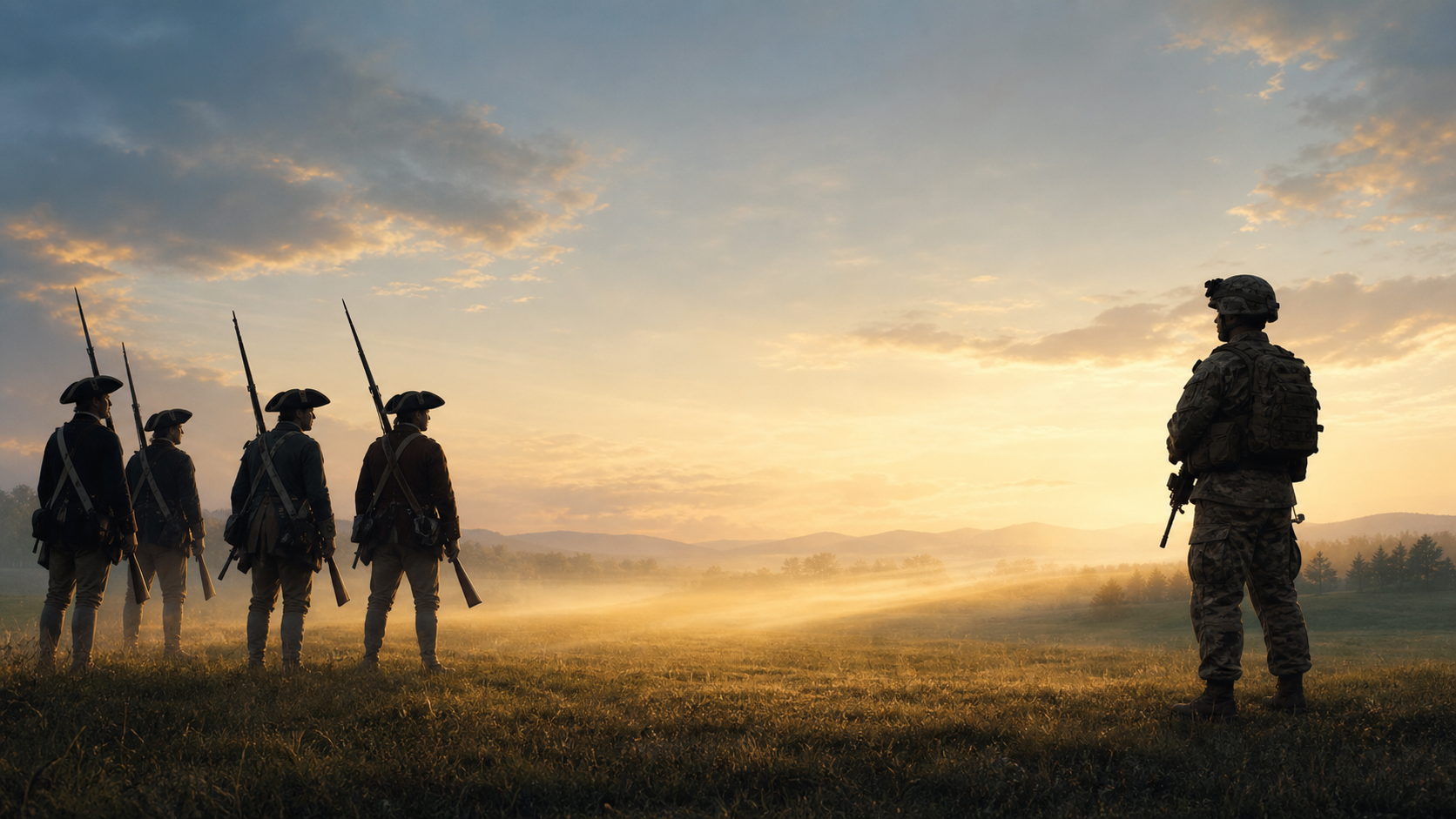
As America prepares to celebrate its 250th birthday in 2026, the U.S. Army is preparing to celebrate its 251st.
That sounds strange at first. How can the Army be older than the country?
The answer is one of the more interesting details in American history: the United States had an Army before it had a Declaration of Independence.
The Declaration of Independence was adopted on July 4, 1776. But the Continental Army was created on June 14, 1775, more than a year earlier. Before America formally announced itself as a new nation, it had already begun building the force that would defend the idea.
The Army Came First
By June 1775, the colonies were already in crisis.
The fighting at Lexington and Concord had happened in April. Colonial militia forces were surrounding British troops in Boston. The relationship between the colonies and Great Britain had moved beyond speeches, petitions, and political protest.
The colonies still had not declared independence. Many people were still uncertain about what the final break with Britain would look like, or whether it would happen at all. But the fighting had already begun.
The Second Continental Congress faced a practical problem: scattered colonial militias could not fight a professional army forever without organization, leadership, supplies, and a common command structure.
So on June 14, 1775, Congress created the Continental Army. The next day, George Washington was selected as commander in chief.
In other words, before America could fully become a country, it had to figure out how to defend itself.
Why That Matters
The creation of the Continental Army was a major step toward nationhood.
Before then, the colonies had local forces with local loyalties. Massachusetts had its militia. Virginia had its militia. Other colonies had their own men, weapons, and priorities. But a war for independence could not be won as thirteen separate efforts moving in thirteen different directions.
The Continental Army gave the colonies something bigger: a shared military purpose.
It was not perfect. The early Army struggled constantly with shortages of food, clothing, weapons, ammunition, medicine, shelter, and pay. Soldiers endured disease, harsh weather, uncertain enlistments, and the fear that the entire cause could collapse.
But the decision to create the Army showed that the colonies were beginning to think and act as one.
That is why the Army’s birthday is more than a ceremonial date. It marks the moment when the defense of American liberty became organized.
Ordinary People, Uncertain Future
It is easy to look back at the Revolution as if the outcome was guaranteed. It was not.
The soldiers of the Continental Army were not legends when they first put on the uniform. They were farmers, tradesmen, laborers, immigrants, young men, older men, and people from different colonies with different backgrounds.
They were fighting for a future they could not fully see.
Many served without knowing whether they would be paid, whether their families would be safe, or whether the cause would survive. Some marched without proper shoes. Some went hungry. Some became sick in camp. Some never came home.
The Army’s story began with uncertainty, sacrifice, and endurance.
From the Continental Army to Today
Over 251 years, the Army has changed almost beyond recognition.
The muskets, wool uniforms, and horse-drawn supply lines of the 18th century gave way to aircraft, armored vehicles, satellites, cyber operations, precision weapons, and global logistics. The missions changed. The technology changed. The uniforms changed.
But the basic idea remains familiar: Americans stepping forward to serve when the country asks.
From the Revolution to the Civil War, from the World Wars to Korea, Vietnam, the Gulf War, Iraq, Afghanistan, and missions around the world, the Army has remained tied to the country’s identity.
That makes the 2026 anniversary especially interesting. America is preparing to celebrate 250 years since the Declaration of Independence, while the Army is preparing to celebrate 251 years since its founding.
The Army is older because the country’s defense had to begin before the country’s founding document was signed.
A Living History
Military history is not just dates, battles, and famous names. It is also made up of individual service members whose lives became part of the larger American story.
A unit history, a service record, a photograph, a deployment order, or a family story can carry meaning long after the moment has passed. Those records help explain where someone served, what they did, what they experienced, and how their service fits into the larger history of the country.
That is true for the Continental Army. It is also true for Veterans today.
For some Veterans, service records matter for family history. For others, they may matter when seeking health care, documenting service, or understanding what happened during a particular assignment, deployment, injury, or event.
The bigger lesson is simple: service becomes history, and records help preserve it.
Bottom Line
America turns 250 in 2026. The U.S. Army turns 251.
That is not a historical accident. It is a reminder that before America declared independence, it had already begun the work of defending it.
The Continental Army started as a practical answer to an urgent problem. Over time, it evolved into one of the central institutions in American life. More than two centuries later, its history is still being written by the soldiers who serve today.
This article is for general information only and is not legal advice. Reading this article or contacting our office does not create an attorney-client relationship unless we agree to representation in writing.